40 “COOL” Winter Olympics Fun Facts for Kids and Teachers (FREE Fact PDF)
Get ready to wow your students with 40 Cool WINTER OLYMPICS FUN FACTS for Kids and Teachers!
Winter Olympics Fun Facts

This fun-packed blog post is bursting with easy-to-share Winter Olympics trivia, from the first-ever Games in snowy Chamonix to wild curling stone secrets and backflip skating drama that kids will love.
40 Winter Olympics Fun Facts
In this post love2teachandlearn (Mrs. T.) will share 40 awesome facts related to these amazing winter games.
Perfect for classroom brain breaks, PE warm-ups, or family game nights, these kid-friendly Winter Olympics facts make history exciting and spark big “wow” moments for teachers and young athletes everywhere!

Hi there, it’s so great to meet you! I’m Mrs. T. (or you can call me Jen) – a Michigan mom, wife, new grandma (aka “Jemma”) K-12 PE teacher, blogger (Love 2 Teach and Learn) and author of 59 CRAZY FUN Elementary PE Games that ROCK!

I love teaching PE class because I get to spend time telling Silly SPORTS JOKES and exercising, while laughing with my students.
I’m also on a serious mission to MAKE SCHOOL FUN AGAIN and I believe this Awesome Collection of Winter Olympics Fun Facts is a great way to do just that!
*AND, if you read all of these awesome Winter Olympics Fun Facts and LOVE THEM SO MUCH, I have a FREE FACT SHEET just for you found below, right after FACT #40.
Winter Olympics Fun Facts
FACT #1
The Winter Olympics are a global sporting event where athletes compete in snow and ice sports.
FACT #2
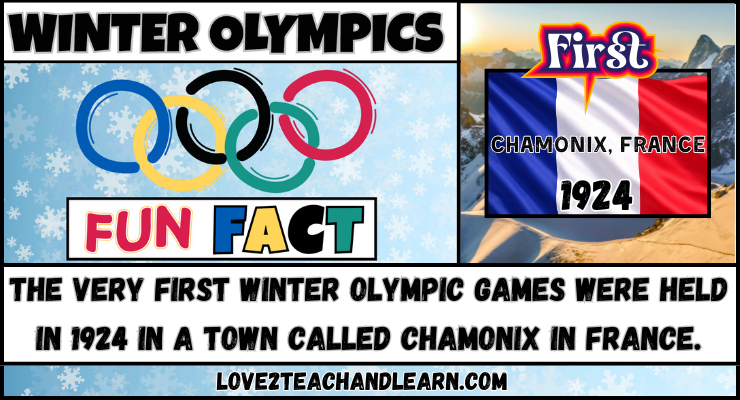
The very first Winter Olympic Games were held in 1924 in a town called Chamonix in France.
FACT #3
The five Olympic rings (blue, yellow, black, green, red) stand for the 5 inhabited continents of the world, with at least one ring color appearing in every nation’s flag.
FACT #4
In bobsleigh, luge, and skeleton, athletes race down an icy track faster than most cars drive on city streets.
FACT #5
Every Winter Olympics has its own mascot, usually a cute animal or character that represents the host country.
FACT #6
The Winter Olympics used to take place in the same year as the Summer Olympics but now happen in different years, two years apart.
FACT #7
Some Winter Olympic events use real snow from the mountains, but many also use machine‑made snow to make sure there is enough.
FACT #8
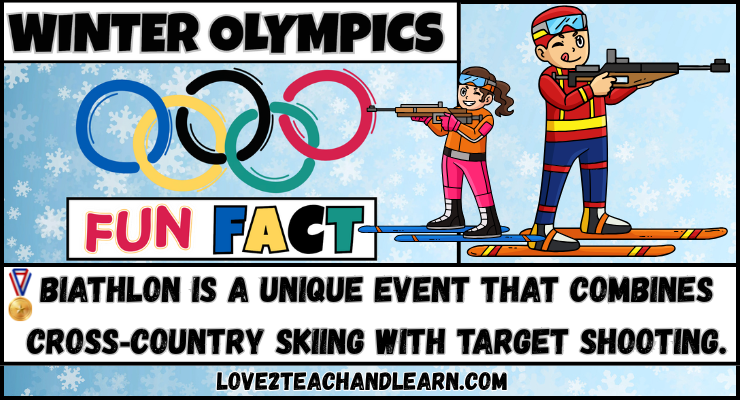
Biathlon is a unique event that combines cross‑country skiing with target shooting.
FACT #9
Figure skating was actually part of the Summer Olympics before the Winter Games existed.
FACT #10
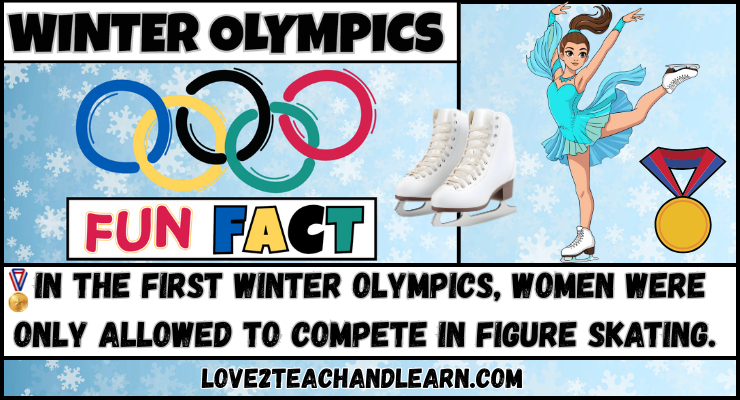
In the first Winter Olympics, women were only allowed to compete in figure skating.
FACT #11
Walt Disney was in charge of the opening and closing ceremonies at the Winter Olympics held in California in 1960. There were 3700 musicians from school bands, 2000 doves (pigeons) and 30,000 balloons.
FACT #12
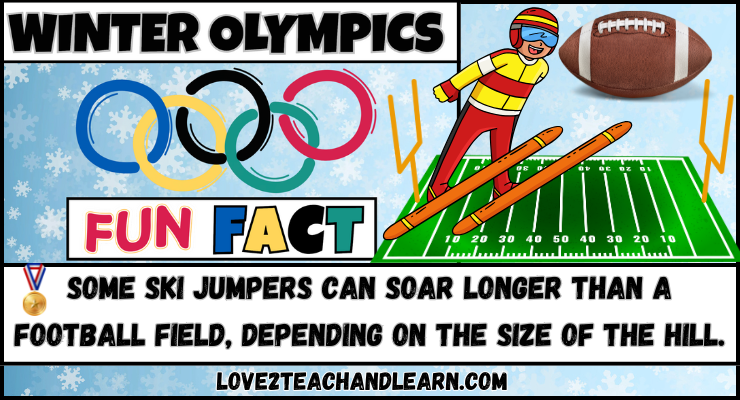
Some ski jumpers can soar longer than a football field, depending on the size of the hill.
FACT #13
Winter Olympic “gold” medals are not pure gold. They are mostly made of silver on the inside and are just coated with a thin layer of real gold (at least about 6 grams) on the outside.
FACT #14
The last Olympic gold medals made of solid gold were awarded at the 1912 Stockholm Summer Olympics.
FACT #15
Ski Mountaineering is a new sport debuting at the 2026 Winter Olympics. It is a winter sport where athletes climb steep snowy mountains using special skis, then ski back down at high speed.
FACT #16
The Winter Olympics weren’t always separate from the Summer Games. Figure skating actually debuted at the 1908 Summer Olympics in London, and ice hockey was in the 1920 Summer Games.
FACT #17
The shortest Olympic events are the short track speed skating sprints and the luge run (just seconds!)
FACT #18
The 2014 Sochi Winter Olympic torch was the first to travel into outer space.
FACT #19
Dogs and horses once participated in the winter Olympics! Dog-sledding (with teams of dogs pulling sleds) was a demonstration sport at the 1932 Lake Placid Winter Olympics, and skijoring (horses pulling skiers) was demonstrated at the 1928 St. Moritz Games. (Topendsports)
FACT #20
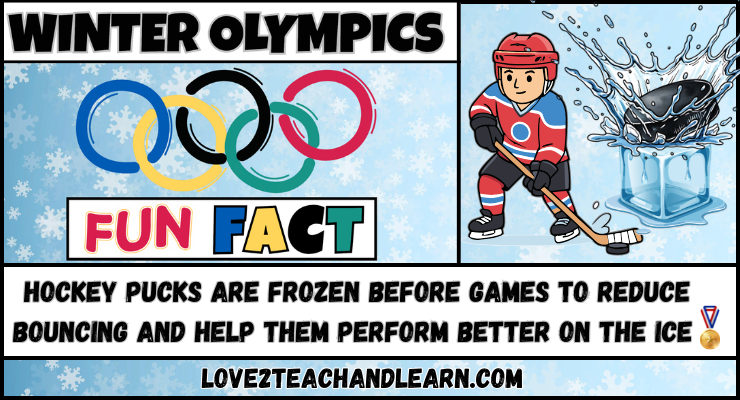
Hockey pucks are frozen before games to reduce bouncing and help them to perform better on the ice.
FACT #21
Eddie Eagan (USA) is the only person to win gold in both Summer (1920, boxing) and Winter (1932, bobsled) Olympics.
FACT #22
All Winter Olympics have been hosted exclusively in the Northern Hemisphere (Europe, North America, Asia) because suitable venues with consistent winter conditions are limited to mountain regions there, while the Southern Hemisphere lacks enough infrastructure, snow reliability, and bidding interest for the Games.
FACT #23
Clarence “Taffy” Abel, an Ojibwe (Sault Ste. Marie Chippewa) defenseman, was the first Native American to compete in the Winter Olympics, representing the U.S. in ice hockey at the 1924 Chamonix Games where he was the flag bearer and helped win silver.
FACT #24
All official curling stones used at the Winter Olympics weight between 38 and 44 pounds and are made from a special granite quarried exclusively from Ailsa Craig, a tiny uninhabited island about 10 miles off Scotland’s west coast.
FACT #25
The backflip in figure skating was banned by the International Skating Union (ISU) in 1977, shortly after Terry Kubicka performed the first one at the 1976 Winter Olympics. The ban was lifted in 2024, allowing it at the 2026 Winter Olympics (Forbes).
FACT #26
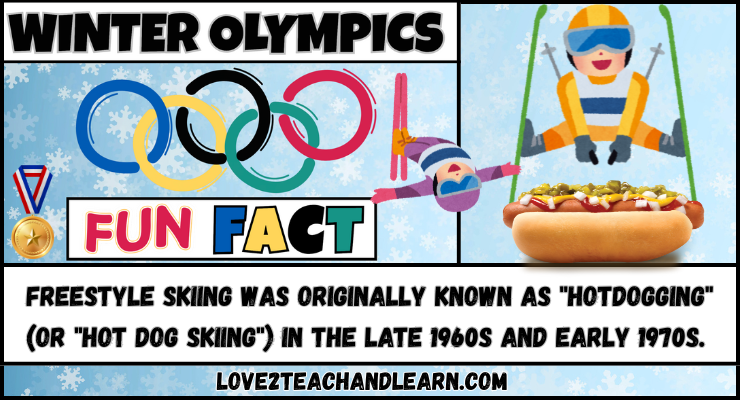
Freestyle skiing was originally known as “hotdogging” (or “hot dog skiing”) in the late 1960s and early 1970s, when daring skiers began performing acrobatic jumps, flips, and showy maneuvers for crowds—earning the nickname from their flashy, crowd-pleasing style before it was formalized as freestyle skiing by the International Ski Federation in 1979. (Dope Snow)
FACT #27
The 2022 Beijing Winter Olympics relied heavily on artificial snow (nearly 100% for many alpine events due to the region’s low natural snowfall).
FACT #28
Speed skaters wear skin-tight “skinsuits” with textured dimples (similar to golf balls) to reduce aerodynamic drag by up to 6-10%—proven in wind tunnel tests. This technology helps shave precious seconds off lap times at speeds over 35 mph.
FACT #29
The United States is the only nation to win at least one medal at every Winter Olympics since their debut in 1924 in Chamonix, France—spanning all 28 Games through 2026.
FACT #30
Winter Olympics take place every 4 years!
FACT #31
The original Olympic motto was “Citius, Altius, Fortius” (“Swifter, Higher, Stronger”), coined by Pierre de Coubertin in 1894 and used through 2020. In 2021, the IOC updated it to “Citius, Altius, Fortius – Communiter” (“Faster, Higher, Stronger – Together”) to emphasize unity, especially post-COVID, and this remains the current official motto.
FACT #32
Cecilia Colledge from Great Britain was the youngest Winter Olympian ever at 11 years and 73 days old, competing in figure skating at the 1932 Lake Placid Games where she placed 8th—she later won silver in 1936. No one younger has competed in any Winter Olympics event. (topendsports)
FACT #33
Many Olympic venues from past Games have been abandoned and overtaken by cobwebs, weeds, and decay due to high maintenance costs, lack of post-event plans, or economic issues.
FACT #34
Male athletes in the ancient Olympic Games competed nude starting around 720 BCE (traditionally after Orsippus of Sparta won a race without his loincloth).
FACT #35
The 2026 Milano Cortina Winter Olympics marked the first time in history that the women’s skiathlon distance matched the men’s at 20 km total (10 km classic + 10 km freestyle), equalizing all cross-country skiing event distances between genders.
FACT #36
Laila Edwards made history at the 2026 Milano Cortina Winter Olympics as the first Black/African American woman to play for the U.S. women’s Olympic ice hockey team, debuting in their opening win over Czechia and later scoring against Canada.
FACT #37
Skimo is short for ski mountaineering- a brand new 2026 winter olympic sport.
FACT #38
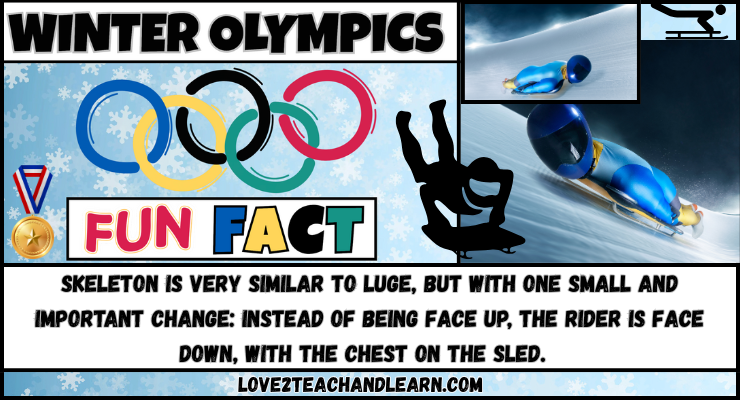
Skeleton is very similar to luge, but with one small and important change: instead of being face up, the rider is face down, with the chest on the sled.
FACT #39
The first Winter Olympics in Chamonix, France (January 25–February 5, 1924) were officially organized as the “International Winter Sports Week” under IOC patronage as a trial event alongside the Paris Summer Games. It was only retrospectively recognized as the I Olympic Winter Games by the IOC in 1925–1926 after its success.
FACT #40
A Canadian Icemaker, Trent Evans, secretly buried a Canadian loonie at center ice at the 2002 Salt Lake City Winter Olympic as a good‑luck charm for Team Canada. Both the Canadian men’s and women’s hockey teams then won gold skating over that “lucky loonie,” and the coin was later recovered and became a famous piece of Canadian Olympic lore.
HAPPY WINTER OLYMPICS
Hey – did you love these 40 Super “Cool” Winter Olympics Fun Facts for Teachers and Kids? If so, here you go:
Get Your FREE 40 WINTER OLYMPICS FUN FACTS PDF HERE!
Thanks so much for stopping by today! I really appreciate it.
I hope that you have a TRULY BLESSED And BEAUTIFUL Day filled with plenty of FUN and FITNESS!
Be sure to check out my other unique and fun PE Gym Resources and Games in my Love 2 Teach and Learn TPT store RIGHT HERE!