DECEMBER PE PLAN: 6 Essential Elementary PE Skills for Month #4
December PE Plan – Welcome to Month #4 of our year-long elementary PE plan!
DECEMBER PE PLAN
In September, we built a strong foundation with gym rules, routines, locomotor skills, body control, teamwork, and sportsmanship.
In October, we developed important object-control skills like underhand rolling, throwing, and catching.
Then, in November, we took things up a notch with overhand throwing, striking, accuracy, and lead passing.
Now it’s time to put those FEET to WORK! 👟⚽
Throughout December, we’re shifting our focus from hand skills to FOOT SKILLS as students learn how to control, move, and manipulate a ball using their feet.
And while these skills are commonly associated with soccer, they’re also fantastic for developing balance, coordination, spatial awareness, teamwork, and overall movement confidence!
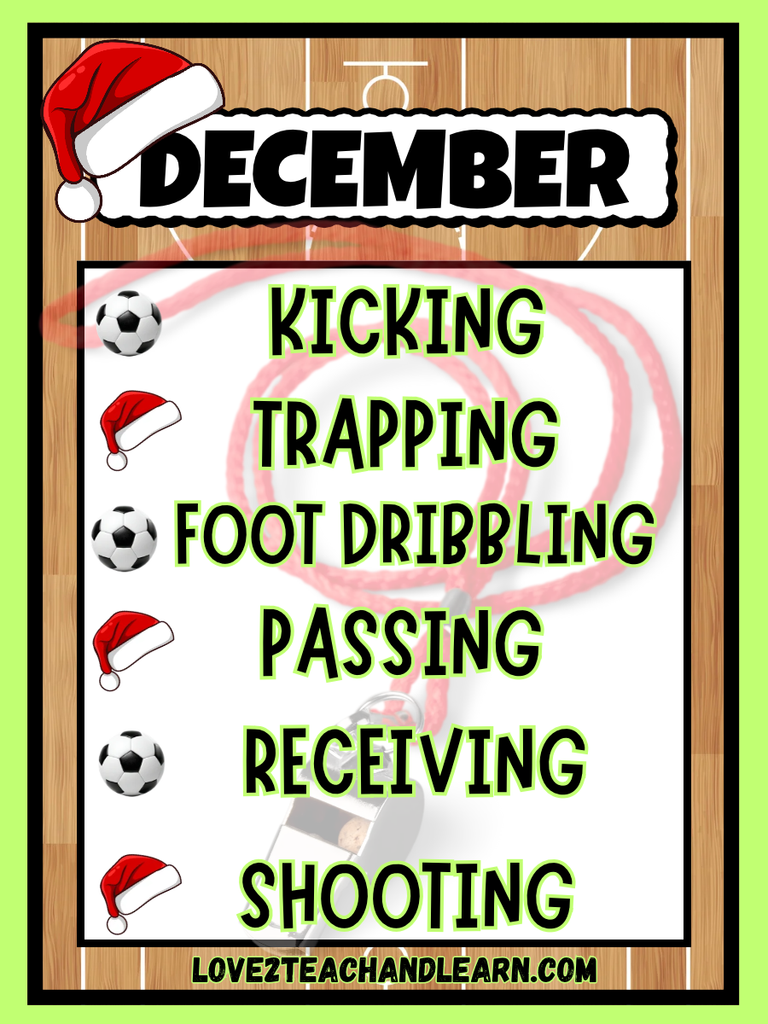
Throughout December, I’ll focus on 6 essential PE skills:
- KICKING
- TRAPPING
- FOOT DRIBBLING
- PASSING
- RECEIVING
- SHOOTING
I’ll break down each skill, share simple teaching cues and success criteria, and give you some of my favorite practice activities, PE read-alouds, and CRAZY FUN games to help your students build their foot skills while having a TOTAL BLAST!
And, if you’re just finding this series, be sure to check out my September PE Plan, October PE Plan, and November PE Plan because each month builds naturally on the one before it, creating a simple, sequential PE curriculum that keeps students learning, progressing, and having CRAZY FUN all year long!
Want to Save Massive Time with my Complete DECEMBER PE Lesson Plan BUNDLE?
YOU GOT IT! You can Snag the Complete Month #4 December Bundle RIGHT HERE!

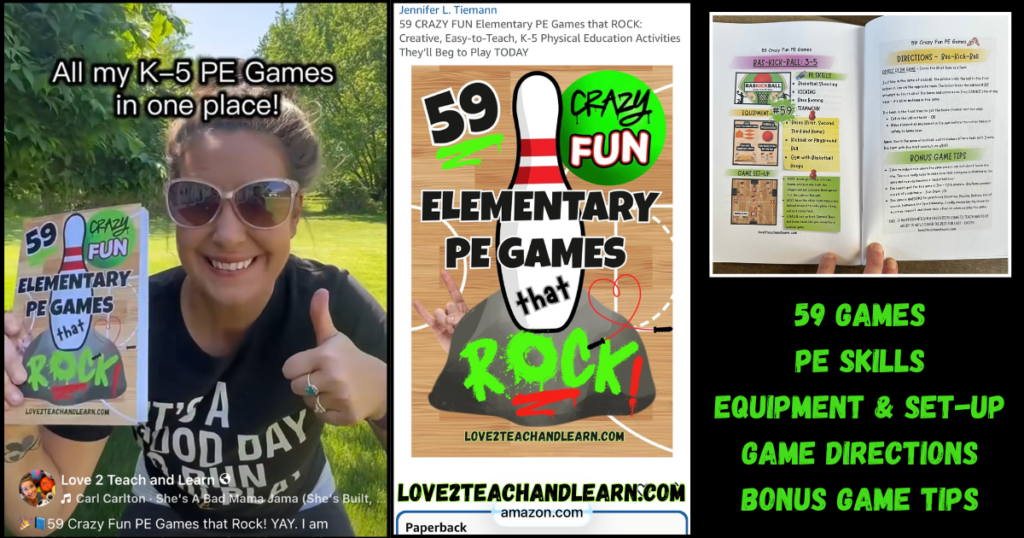
Hi there, it’s so great to meet you! I’m Mrs. T. (or you can call me Jen) – a Michigan mom, wife, new grandma (aka “Jemma”) K-12 PE teacher, blogger (Love 2 Teach and Learn) and author of 59 CRAZY FUN Elementary PE Games that ROCK!
I love teaching PE class because I get to spend time telling Silly SPORTS JOKES and exercising, while laughing with my students.
I’m also on a serious mission to MAKE SCHOOL FUN AGAIN and I believe physical education class is the ABSOLUTE BEST WAY to do just that!
READY! SET! LET’S MAKE SCHOOL FUN AGAIN!
KICKING ⚽
KICKING is one of the most important foundational foot skills students learn in elementary PE because it teaches them how to use their feet to send an object in a desired direction with control and accuracy.
After spending November developing our hand-eye coordination and striking skills, December is the perfect time to switch things up and introduce FOOT-EYE coordination!
Before we start dribbling, passing, or shooting, students need to understand how to make contact with a ball using their feet.
HOW TO TEACH IT
QUICK INTRO
DEFINE and EXPLAIN what kicking actually is. The kid-friendly definition that I use to teach kicking to my students is:
- Using your foot to strike a ball and send it in a desired direction.
MAKE A REAL-WORLD CONNECTION – Ask your students: “What sports or games can you think of where you use your FEET to KICK a ball?”
- Give students a chance to brainstorm examples like soccer, football, kickball, rugby, and playground games.
- Explain that learning how to kick with proper form helps students develop balance, coordination, power, and control that they can use in LOTS of different activities!
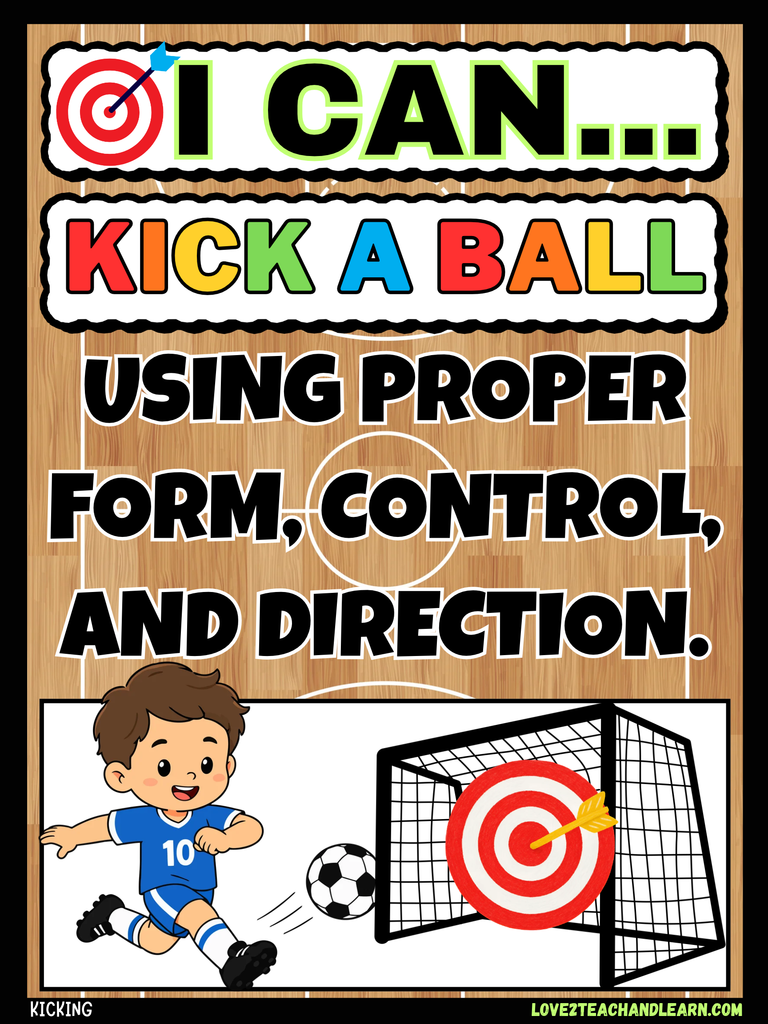
RECITE – Then have students recite the kicking “I CAN” Statement:
- I CAN…KICK A BALL USING PROPER FORM, CONTROL, AND DIRECTION.
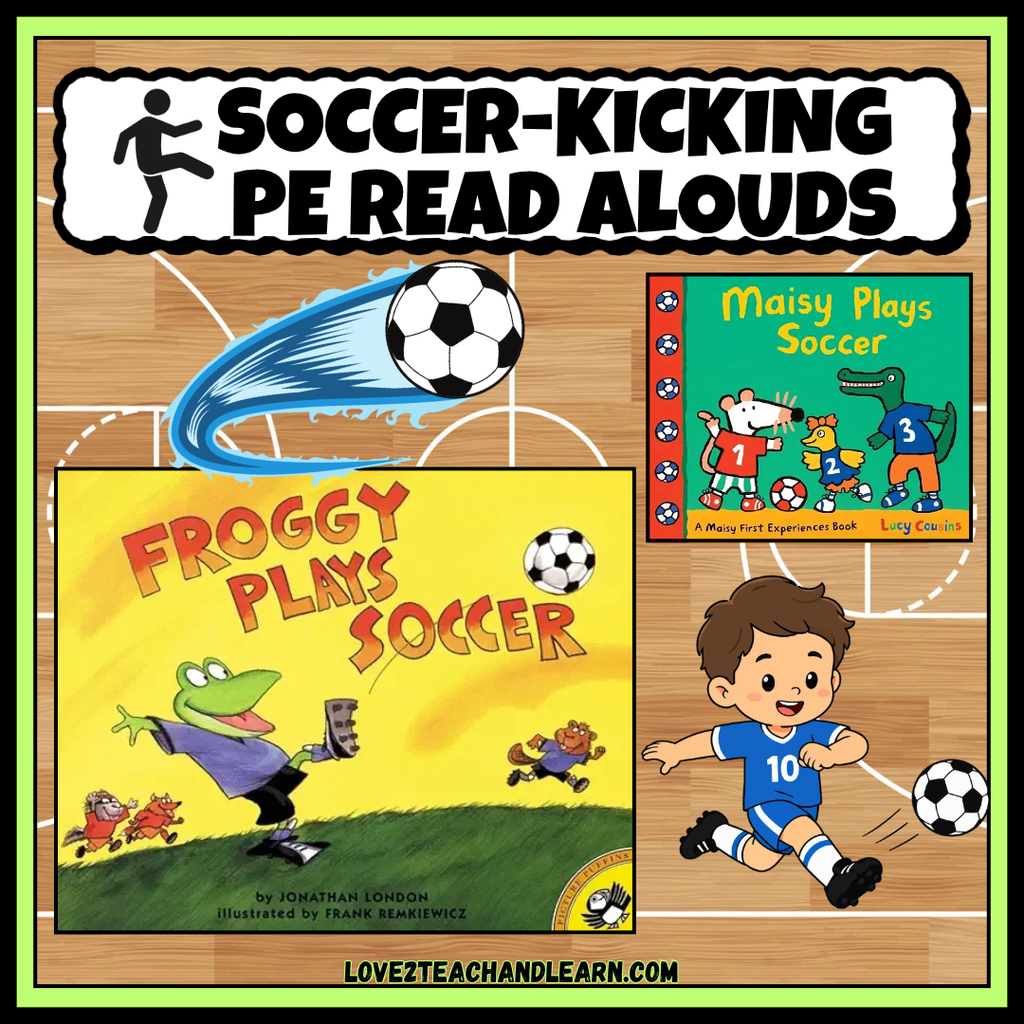
READ ALOUD THE BOOK: Froggy Plays Soccer by Jonathan London – This is a fun, silly read-aloud for K–3 students that makes a great introduction to our December foot skills unit! Froggy’s soccer adventures provide an opportunity to discuss kicking, practicing new skills, teamwork, and having fun while learning.
- I prefer to read aloud the physical book to my students, however, you can watch and listen to the story on YouTube RIGHT HERE.
Another great option is Maisy Plays Soccer by Lucy Cousins, especially for kindergarten and first grade.
MODEL the skill of kicking for your students.
- Demonstrate approaching a stationary ball, placing your non-kicking foot beside it, keeping your eyes on the ball, contacting the ball with the inside of your foot or shoelaces, and following through toward your target.
- Show students how a gentle kick and a powerful kick can send the same ball different distances.
CUE WORDS & SUCCESS CRITERIA
TEACH CUE WORDS – I like to keep kicking cues super simple so students can remember them easily:
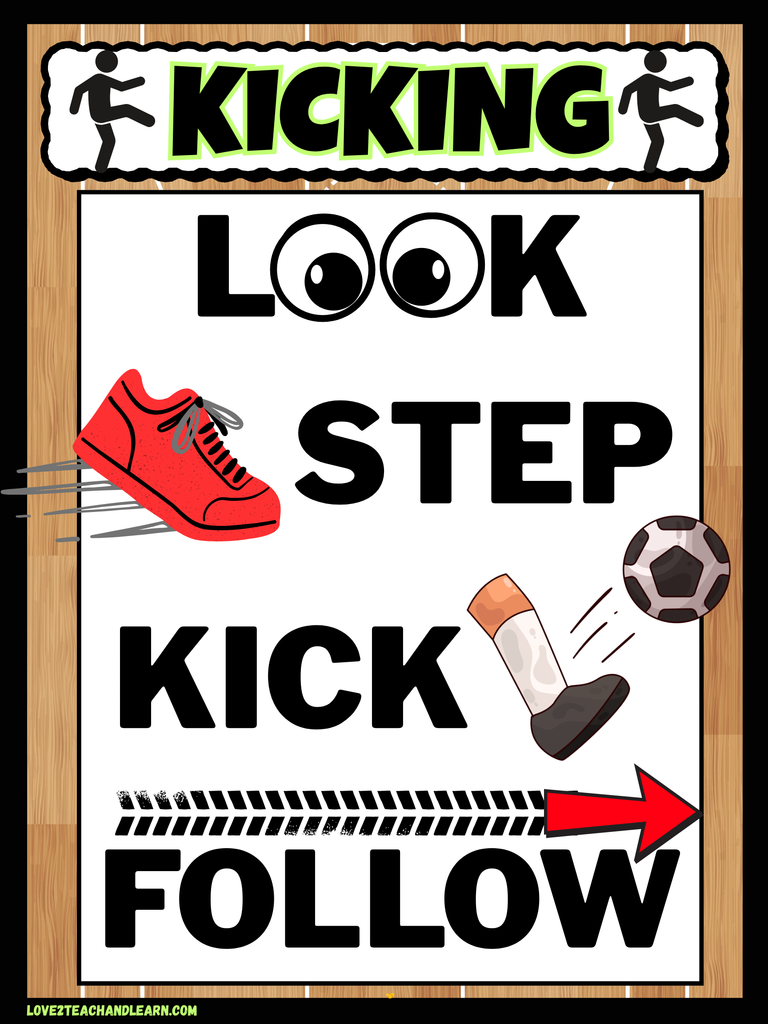
LOOK – STEP – KICK- FOLLOW
- 👀 LOOK – Keep your eyes on the ball.
- 👟 STEP – Place your non-kicking foot beside the ball.
- ⚽ KICK – Strike the ball with the inside of your foot or shoelaces.
- ➡️ FOLLOW – Follow through toward your target.
⭐ EXPLAIN SUCCESS CRITERIA – I am successful when I LOOK at the ball, STEP beside it with my non-kicking foot, KICK with control, and FOLLOW THROUGH toward my target.
Have students practice the LOOK – STEP – KICK – FOLLOW motion without a ball before trying it with equipment.
STUDENT PRACTICE ACTIVITIES
PRACTICE – I like to begin with stationary balls and large targets before gradually introducing movement, distance, and accuracy.
Here are several easy kicking practice activities:
- ⚽ SHADOW KICKS – Students practice their kicking motion without a ball, focusing on stepping beside the imaginary ball and following through.
- 🎯 KICK THE CONE – Give each student a ball and a large cone target. Students practice kicking from a short distance and try to hit or knock over their cone.
- 🌈 RAINBOW KICKS – Set up six colored hula hoops or designated target zones. Students practice kicking their ball toward different colored targets called out by the teacher.
- 👟 KICK AND CHASE – Students gently kick their ball into an open space, travel to retrieve it, stop it, and repeat.
- 🚪 GATE KICKING – Create small gates using pairs of cones. Students practice kicking their ball through the gates with control and accuracy.
- 💪 POWER ZONES – Mark three kicking distance zones using cones or floor tape. Students experiment with using different amounts of force to send their ball into each zone.
DIFFERENTIATE – Remember to adjust the challenge based on your students’ grade and skill levels.
- K–2: Keep it BIG, CLOSE, SOFT, and SIMPLE! Use larger lightweight balls, short distances, and big targets. Focus on making successful contact and developing proper kicking form.
- 3–5: Increase the challenge with smaller targets, longer distances, moving approaches, and kicking with both feet. Encourage students to adjust force and direction while maintaining control.
FAVORITE MAIN PE KICKING GAMES
PLAY FUN KICKING PRACTICE GAMES – Now that students understand the basic kicking cues, it’s time to turn those skills into some CRAZY FUN PE games!
My three favorite kicking games are:
- SOCCER BOWLING – Set up bowling pins at the end of several shooting lanes. Students take turns shooting soccer balls toward the pins, attempting to knock down as many as possible using proper kicking form. This is a perfect way to connect October’s underhand rolling and bowling skills with December’s kicking skills!
- ⚽🏀 BAS-KICK-BALL is a truly AWESOME addition to our December KICKING unit because it combines the FUN of kickball and basketball into one CRAZY FUN team game! Students practice their kicking skills while reviewing previously learned skills like throwing and catching —all while developing teamwork, sportsmanship, and having a TOTAL BLAST! Get all of the “How to Play” game details RIGHT HERE. It’s also Game #59 in my 59 CRAZY FUN PE Games book.
- LUCKY PIN – This is a PERFECT game to include in our December KICKING unit because students get to practice their kicking accuracy, control, and force while reviewing previously learned skills like underhand rolling, underhand throwing, and catching! I especially LOVE that students can CHOOSE which skill to use, encouraging strategy, decision-making, and problem-solving while having a TOTAL BLAST! Get all of the “How to Play” game details RIGHT HERE. It’s also Game #25 in my 59 CRAZY FUN PE Games book.
ASSESSMENT
ASSESSMENT – 3-ATTEMPT KICKING CHALLENGE
Give each student three opportunities to kick a stationary ball toward a large target from the same starting spot.
Look for five simple criteria:
- EYES on the ball.
- STEPS beside the ball with the non-kicking foot.
- CONTACTS the ball with the inside of the foot or shoelaces.
- FOLLOWS THROUGH toward the target.
- Demonstrates CONTROL and DIRECTION.
📋A quick checklist makes it easy to identify students who have mastered the basic kicking pattern and those who need additional practice.
TRAPPING ⚽
Now that students have learned how to KICK a ball, it’s time to introduce another essential foot skill—TRAPPING!
Trapping teaches students how to STOP and CONTROL a moving ball using their feet.
This is an especially important skill because students need to be able to stop a ball before they can successfully dribble, pass, or shoot it in a game.
I love teaching trapping immediately after kicking because the two skills naturally work together!
HOW TO TEACH IT
QUICK INTRO
DEFINE and EXPLAIN what trapping actually is. The kid-friendly definition that I use is:
– Using your foot to stop a moving ball and bring it under control.
MAKE A REAL-WORLD CONNECTION – Ask your students: “Why do you think it’s important to be able to STOP a moving ball with your feet?”
- Give students a chance to brainstorm and turn and talk with a partner. Then, explain that being able to trap a moving ball helps players maintain possession, change directions, and prepare for their next move.
- Remind students that great soccer players don’t just know how to KICK the ball—they know how to STOP it too!
RECITE – Then have students recite the trapping “I CAN” Statement:
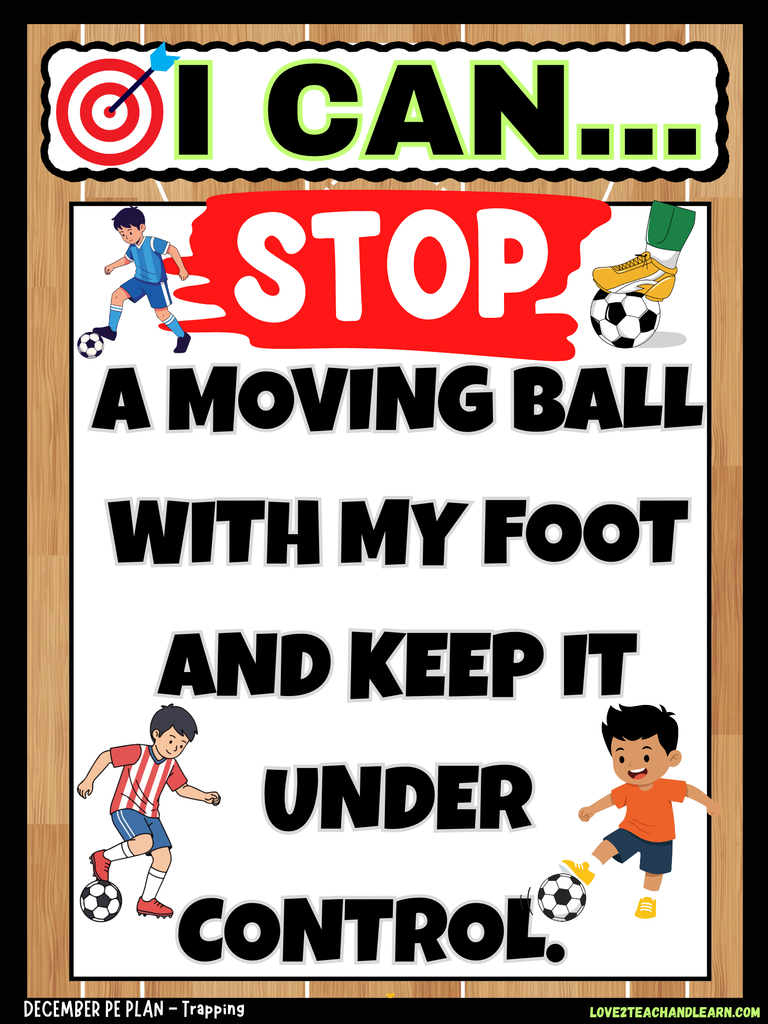
- I CAN… STOP A MOVING BALL WITH MY FOOT AND KEEP IT UNDER CONTROL.
READ ALOUD CONNECTION: Revisit Maisy Plays Soccer by Lucy Cousins.
ASK students to imagine what would happen if the soccer players could kick the ball but couldn’t stop it! This makes a great discussion starter about the importance of ball control.
MODEL the skill of trapping for your students.
- Begin with a slowly rolling ball.
- Demonstrate watching the ball as it approaches, moving into position, gently placing the sole of your foot on top of the ball, and stopping it without losing your balance.
- Emphasize that trapping isn’t about STOMPING on the ball! It’s about using a gentle, controlled touch.
CUE WORDS & SUCCESS CRITERIA
TEACH CUE WORDS – I like to use these four simple trapping cues:
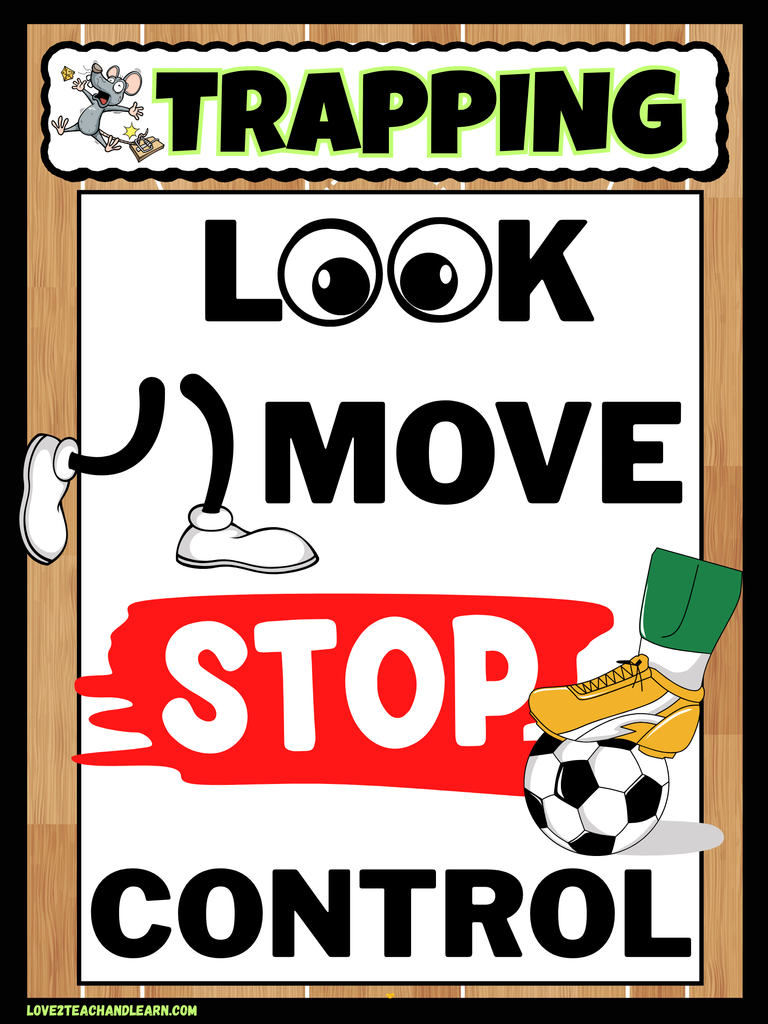
LOOK – MOVE – STOP – CONTROL
- 👀 LOOK – Keep your eyes on the approaching ball.
- 👟 MOVE – Move your body into position.
- 🛑 STOP – Gently stop the ball with the sole or inside of your foot.
- ⚽ CONTROL – Keep the ball close and ready for your next move.
⭐ EXPLAIN SUCCESS CRITERIA – I am successful when I LOOK at the approaching ball, MOVE into position, STOP the ball gently with my foot, and keep it under CONTROL.
REMIND students that a successful trap means the ball stays close enough for them to kick, pass, or dribble it again.
STUDENT PRACTICE ACTIVITIES
PRACTICE – Start with slow-moving balls before increasing speed and adding partners.
Here are several easy trapping practice activities:
- 🛑 ROLL AND STOP – Students gently roll their own ball forward with their hands, move toward it, and stop it using the sole of their foot.
- 👟 SOCCER FREEZE – Students gently move their soccer balls around their personal space. When the music stops, they must immediately trap their ball and FREEZE with one foot on top.
- 🤝 PARTNER ROLL AND TRAP – Partners stand several feet apart. One partner rolls the ball while the other traps it with their foot before rolling it back.
- 🔴🟡🟢 TRAFFIC LIGHT TRAPPING – GREEN means move the ball gently, YELLOW means slow down, and RED means trap and freeze!
- 🎯 TRAP THE TARGET – Place a poly spot or small hoop in front of each student. Students try to stop a gently rolling ball on or near their target.
- 🔄 TRAP AND TURN – After successfully trapping the ball, students use their foot to turn the ball in a new direction.
DIFFERENTIATE
- K–2: Use larger, softer balls that roll slowly. Allow students to begin with stationary balls and practice placing their foot on top before introducing moving balls.
- 3–5: Increase the speed and distance of the incoming ball. Challenge students to trap using either foot, receive balls from different angles, and transition immediately into another movement.
FAVORITE MAIN PE KICKING GAMES
PLAY FUN TRAPPING PRACTICE GAMES – Here are three games that help students practice stopping a moving ball while having a BLAST!
- 🚀 ROCKET STOPPERS – Partners stand across from each other with one ball. One student sends a rolling “rocket” toward their partner, who must stop it before it passes their designated stopping line.
- ⚽🥔 HOT POTATO SOCCER TAG (Trapping Edition) – It’s a CRAZY FUN twist on my original Hot Potato Tag game, but this time we’re using our FEET to practice KICKING and TRAPPING instead of throwing and catching! Partners gently kick the soccer ball back and forth, TRAPPING it before each pass, until the music suddenly stops and the student with the ball becomes the HOT POTATO TAGGER! The tagger then attempts to kick the ball toward their partner’s feet before they reach the safety line, while the runner can escape by reaching the line OR successfully trapping the approaching ball!
- 🚦 SOCCER TRAFFIC JAM – Every student has a soccer ball and moves around the gym using gentle kicks while the music plays. When the teacher yells “TRAFFIC JAM!” students must quickly TRAP their ball with the sole of their foot and FREEZE! Then, add silly commands like “U-TURN,” “SPEED BUMP,” and “PARKING LOT” to keep students laughing and practicing ball control.
ASSESSMENT
ASSESSMENT – 3-ATTEMPT TRAPPING CHALLENGE
Have a partner or teacher gently roll a ball toward each student three times.
Look for five simple criteria:
- LOOKS at the approaching ball.
- MOVES into position.
- Uses the SOLE or INSIDE of the foot to stop the ball.
- Demonstrates BALANCE while trapping.
- Keeps the ball CLOSE and under CONTROL.
The goal is to stop the ball successfully and maintain possession rather than letting it roll away.
📋A quick checklist makes it easy to identify students who have mastered the basic kicking pattern and those who need additional practice.
FOOT DRIBBLING ⚽
Now that students have practiced kicking and trapping, it’s time to combine those skills and introduce FOOT DRIBBLING!
Foot dribbling is one of my favorite soccer skills to teach because it gets students moving, challenges their coordination, and creates SO MANY opportunities for fun games!
Students learn how to use small, controlled touches to move a ball around the gym while keeping it close to their feet.
It’s also a great way to reinforce personal space, pathways, speed, and body control from our September PE Plan!
HOW TO TEACH IT
QUICK INTRO
DEFINE and EXPLAIN what foot dribbling actually is. The kid-friendly definition I use is:
- Moving a ball with your feet using small, tiny taps while keeping it under control.
MAKE A REAL-WORLD CONNECTION – Ask your students: “Have you ever watched a soccer player run down the field while keeping the ball close to their feet?”
- Explain that soccer players use foot dribbling to travel with the ball, avoid defenders, change directions, and create scoring opportunities.
- Remind students that dribbling isn’t about kicking the ball as FAR as possible. It’s about keeping the ball close enough to control it!
RECITE – Then have students recite the foot dribbling “I CAN” Statement:
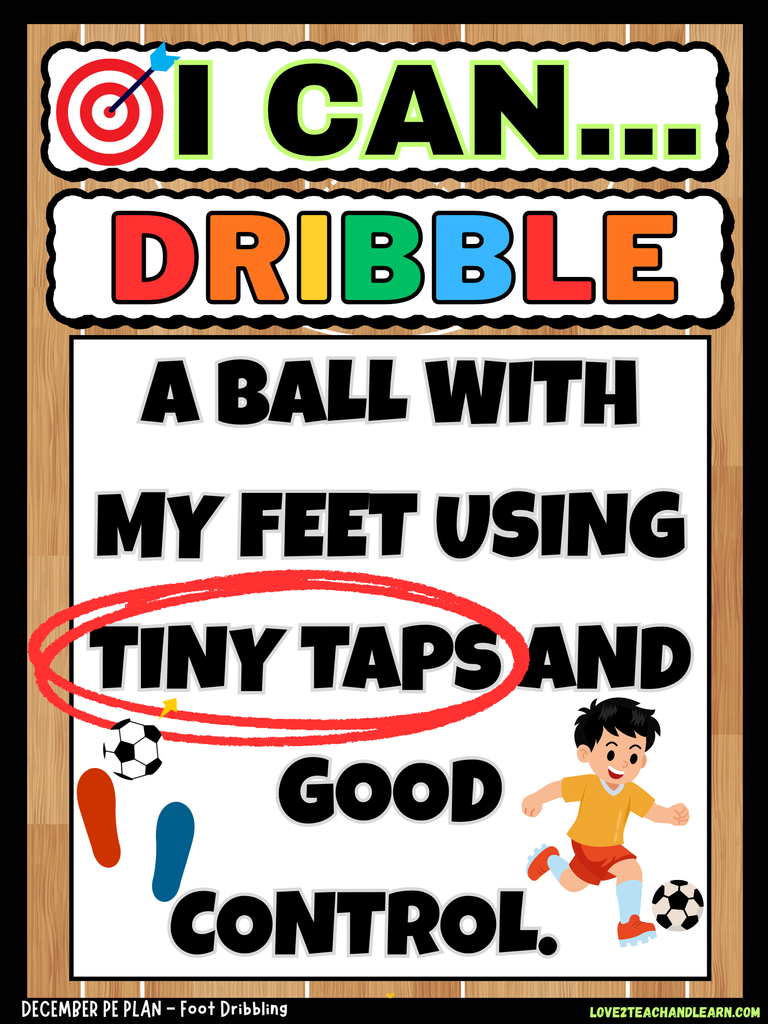
- I CAN… DRIBBLE A BALL WITH MY FEET USING TINY TAPS AND GOOD CONTROL.
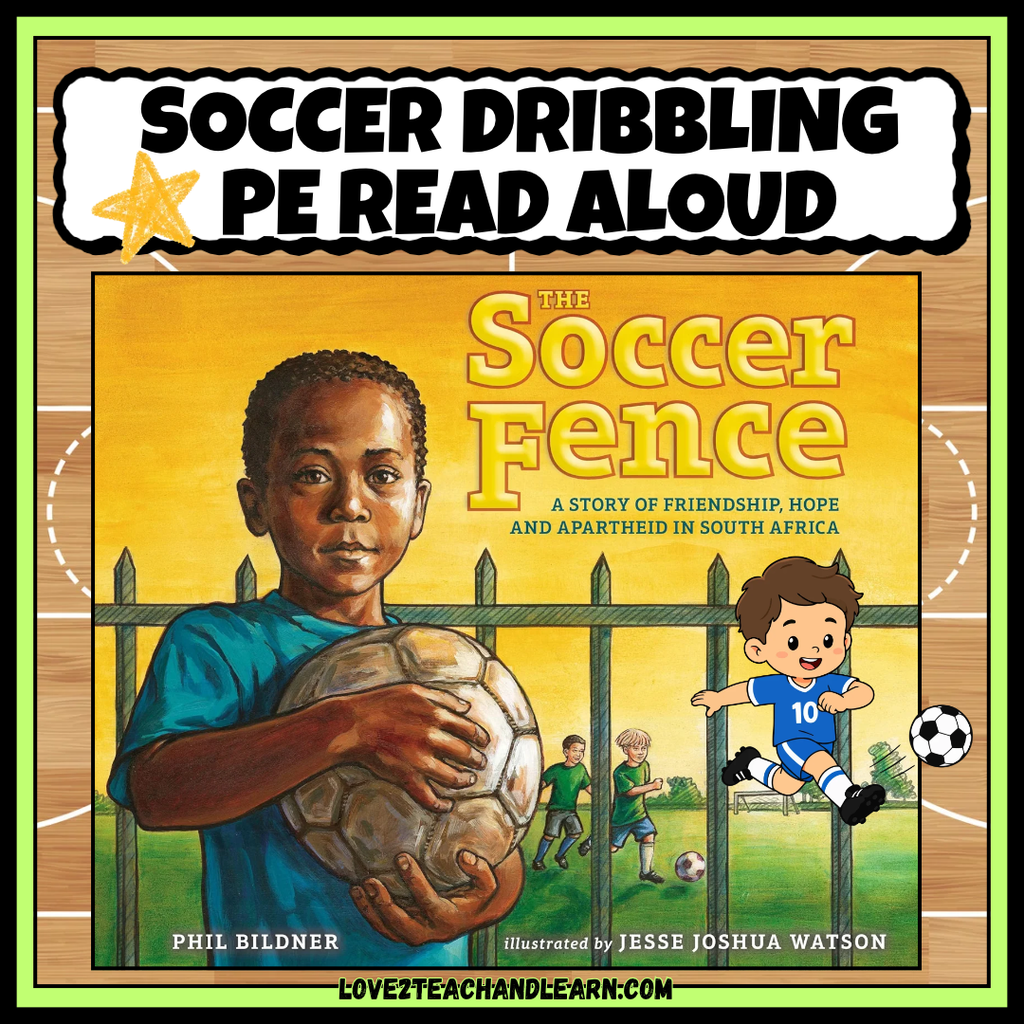
READ ALOUD THE BOOK: The Soccer Fence by Phil Bildner. This soccer-themed story provides a wonderful opportunity to connect foot skills with perseverance, teamwork, inclusion, and the power of sports to bring people together. It is especially appropriate for upper elementary students.
- I prefer to read aloud the physical book to my students, however, you can watch and listen to the story on YouTube RIGHT HERE. PLEASE NOTE: This is a lengthy book and video (about 20 minutes) so you may want to watch it over the course of a few PE periods.
MODEL the skill of foot dribbling for your students.
- Demonstrate using gentle touches (TINY TAPS) with the inside and outside of your feet to move the ball forward.
- Keep the ball close, bend your knees slightly, and take small steps.
- Show students how to look up briefly to see where they’re going while still keeping track of their ball.
I also like to demonstrate what NOT to do by giving the ball one HUGE kick and then chasing it across the gym! Students usually get a good laugh, and it helps them understand why small touches are so important.
CUE WORDS & SUCCESS CRITERIA
TEACH CUE WORDS – These two simple cue words work beautifully for elementary students:
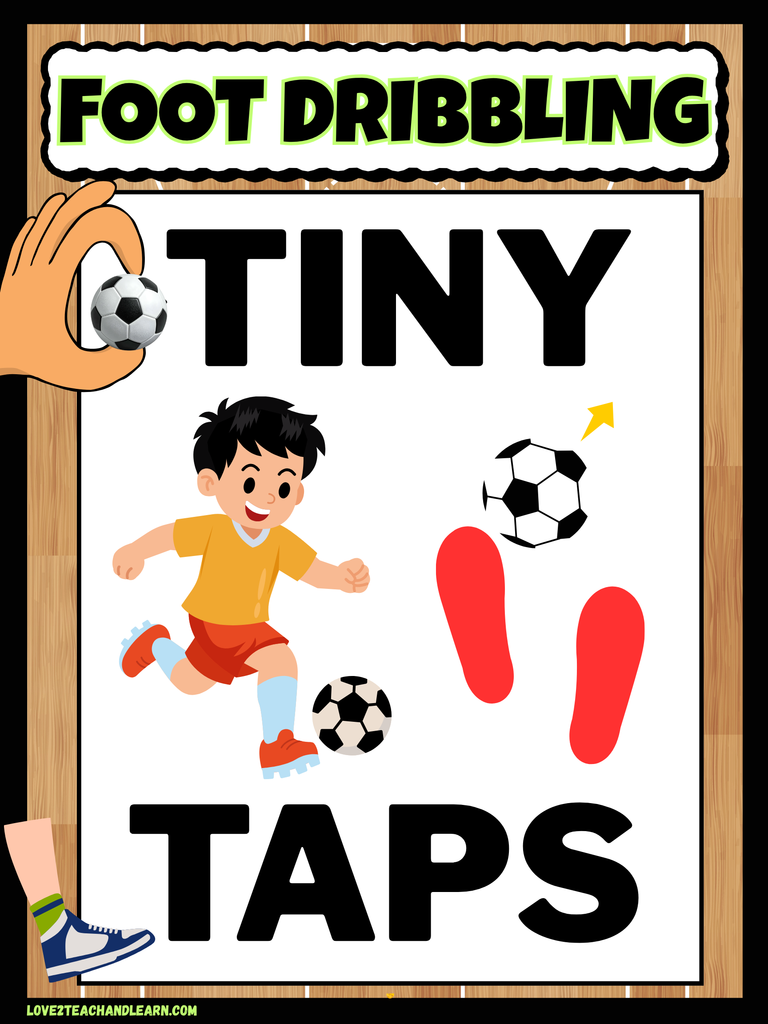
TINY TAPS
Using the simple cue words “TINY TAPS” helps students remember to use small, gentle touches with their feet instead of BIG kicks, allowing them to keep the ball close, maintain better control, and build confidence while dribbling!
⭐ EXPLAIN SUCCESS CRITERIA – I am successful when I use TINY TAPS with my feet to keep the ball close and under control while dribbling in different directions.
STUDENT PRACTICE ACTIVITIES
BONUS TEACHER TIP – One of my FAVORITE strategies for introducing FOOT DRIBBLING to elementary students is something I call “BAGS BEFORE BALLS!”
Before handing out soccer balls, I have my students practice dribbling with BEANBAGS first!
Beanbags don’t roll away like soccer balls, making it much easier for students to focus on using TINY TAPS, developing foot-eye coordination, and keeping their equipment close and under control.
Once students have mastered those gentle, controlled touches, we graduate to soccer balls!
It’s a SUPER SIMPLE way to build confidence, reduce frustration, and set students up for SUCCESS!
PRACTICE – Begin with stationary ball touches and progress to dribbling in open space before introducing obstacles or defenders.
Here are several fun foot dribbling practice activities:
- 👟 SOCCER TOE TAPS – Students alternate gently tapping the top of a stationary ball with the soles of their feet while maintaining balance.
- ⚽ TINY TOUCHES – Students dribble their ball using the smallest, gentlest touches possible.
- 🐢🐇 TURTLE AND RABBIT – Call out TURTLE for slow dribbling and RABBIT for slightly faster dribbling while maintaining control.
- 🌈 RAINBOW CONE WEAVE – Set up a colorful line of cones and challenge students to dribble around each cone without touching it.
- 🔄 FIGURE EIGHT DRIBBLING – Students dribble their ball in a figure-eight pattern around two cones.
- 👟 SWITCH FEET – Challenge students to alternate their right and left feet while dribbling.
DIFFERENTIATE
- K–2: Begin with stationary toe taps and gentle dribbling in a large open space. Encourage students to walk rather than run while learning to keep the ball close.
- 3–5: Add changes of speed, direction, pathways, obstacles, and defensive pressure. Challenge students to use both feet and occasionally look up while dribbling.
FAVORITE MAIN PE FOOT DRIBBLING GAMES
PLAY FUN FOOT DRIBBLING PRACTICE GAMES – This is where foot skills get REALLY FUN!
Here are three Awesome foot dribbling games your students can try:
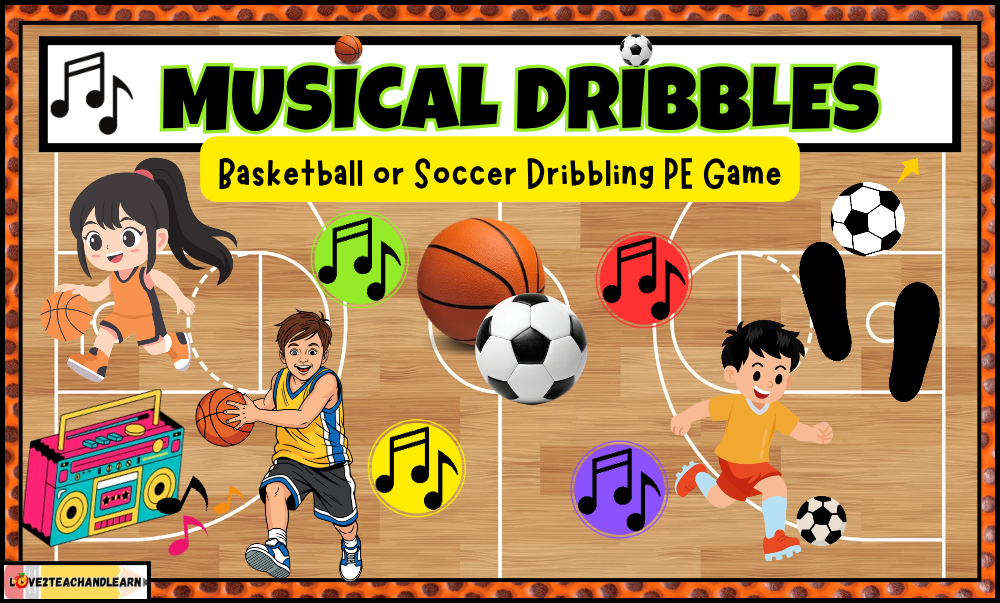
- 🎶⚽MUSICAL DRIBBLES – This is one of my FAVORITE CRAZY FUN PE games because it works AMAZINGLY WELL for practicing BOTH soccer foot dribbling AND basketball dribbling (which we will get to in our JANUARY PE PLAN!) This musical chairs-inspired game keeps students practicing their dribbling skills as they move around the gym to upbeat music and race to find an open poly spot when the music stops! When playing the SOCCER version, students focus on using TINY TAPS to keep their ball (or BEANBAG) close and under control. Get all of the “How to Play” game details RIGHT HERE, as well as a quick video tutorial for you. It is also Game #54 in my 59 CRAZY FUN PE Games book.
- 💰DRIBBLIN’ FOR DOLLARS – This is a CRAZY FUN soccer dribbling relay game that combines foot dribbling, trapping, teamwork, and a little MATH! Scatter colorful poly spots with hidden amounts of fake money underneath throughout the gym, and have students take turns using TINY TAPS to dribble their soccer balls to a money dot, TRAP their ball on top of it, collect the dot, and dribble back to their team! Once ALL the money dots have been collected, teams add up their earnings, and the team with the MOST DOUGH WINS!
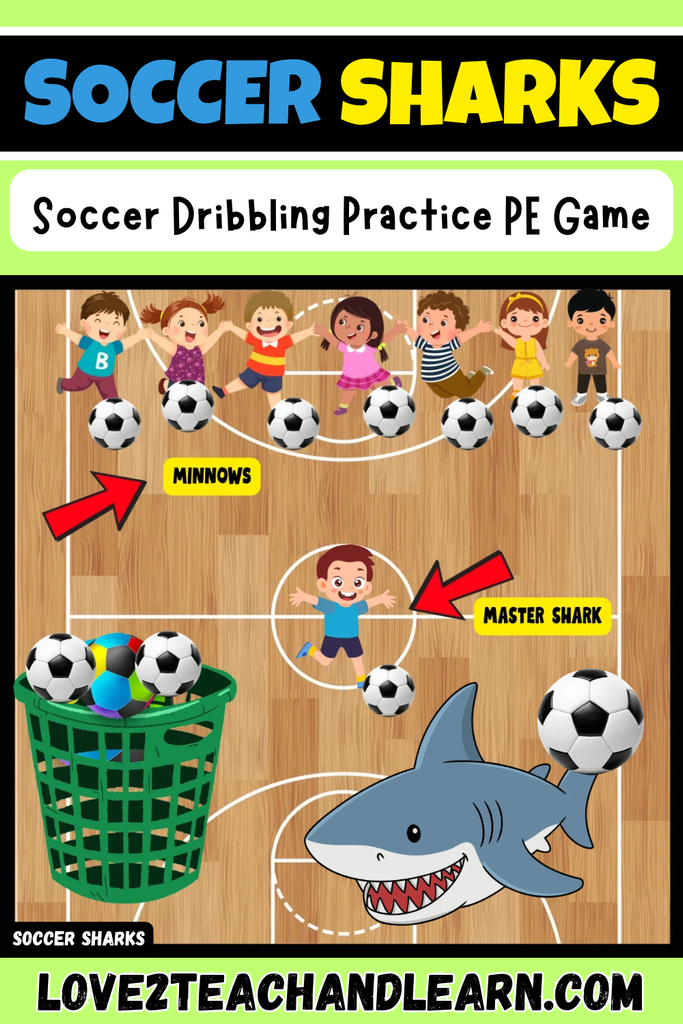
- 🦈 SOCCER SHARKS – This is a FUN soccer twist on the classic Sharks and Minnows game that’s PERFECT for practicing foot dribbling, ball control, and spatial awareness! One student starts in the middle of the gym as the SOCCER SHARK, while the remaining students (MINNOWS) line up along one end with their soccer balls. When the shark yells “SHARK ATTACK!”, the minnows use TINY TAPS to dribble across the gym without having their soccer balls kicked away by the shark! Any minnow who loses their ball to a shark becomes a SHARK for the next round, and the game continues until only ONE lucky minnow remains!
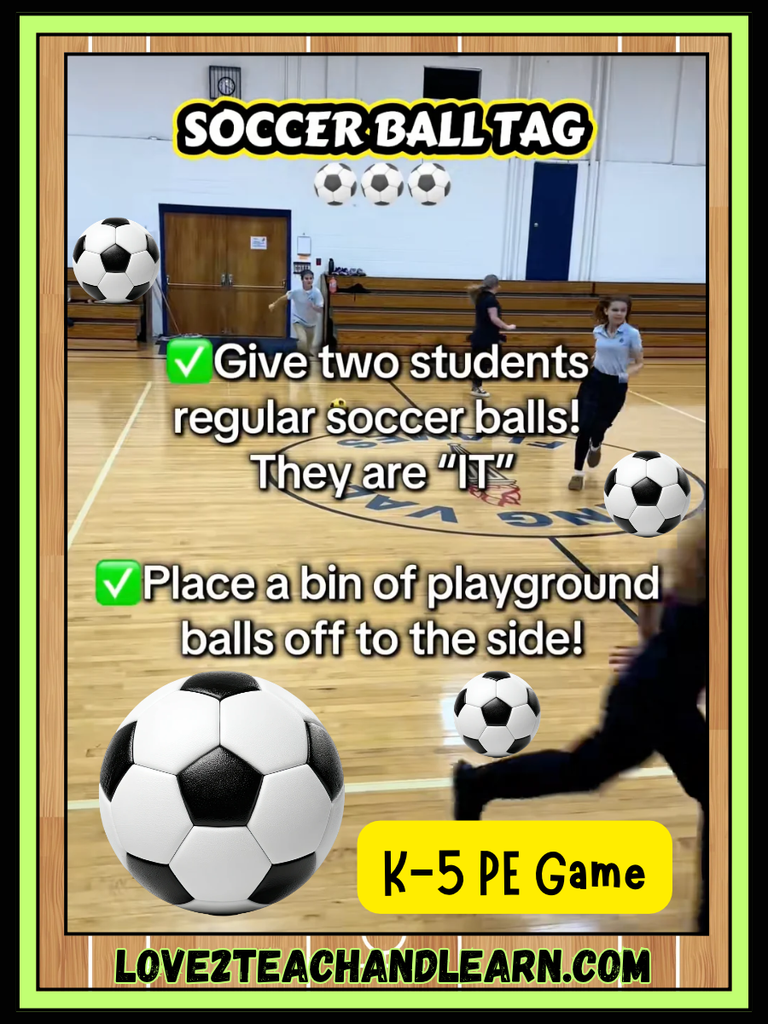
- SOCCER BALL TAG – This is a CRAZY FUN twist on traditional tag that combines soccer dribbling, kicking, teamwork, and LOTS of movement! Start with TWO taggers who each have a soccer ball, while everyone else runs around the gym trying to avoid getting tagged! The “IT TEAM” uses TINY TAPS to dribble their soccer balls and gently kick them toward other students’ legs (KNEES OR BELOW) to score ONE POINT per tag. When tagged, students grab a soccer ball and JOIN THE IT TEAM! After 90 seconds, count up the team’s points, choose two NEW starting taggers, and play again to see which team can score the MOST POINTS! You can watch exactly how to play “SOCCER BALL TAG” RIGHT HERE.
- ⚽🛑 DRIBBLE, STOP, GO! is a CRAZY FUN soccer twist on the classic Red Light, Green Light game that’s PERFECT for practicing foot dribbling, trapping, and ball control! One student starts as the CALLER and uses the DRIBBLE-STOP-GO paddle to give commands while the other students use TINY TAPS to dribble their soccer balls toward the caller. When the caller yells “STOP!”, students must immediately TRAP their soccer ball with their foot and FREEZE! If a student loses control of their ball, they return to the starting line, and the FIRST player to reach the caller WINS and becomes the new caller for the next round!
ASSESSMENT
ASSESSMENT – 3-ATTEMPT FOOT DRIBBLING CHALLENGE
Have students dribble their soccer ball through a short pathway or around a few cones three times. Observe whether they demonstrate the three success criteria during each attempt.
Look for:
- Uses TINY TAPS instead of big kicks.
- Keeps the ball CLOSE and under CONTROL.
- Dribbles while MOVING and CHANGING DIRECTION
Encourage students to improve their control and confidence from Attempt #1 to Attempt #3.
📋A quick checklist makes it easy to identify students who have mastered the basic foot dribbling and those who need additional practice.
PASSING ⚽
Now that students have learned how to kick, trap, and dribble a soccer ball, it’s time to introduce another SUPER IMPORTANT foot skill—PASSING!
Passing is fun to teach because it combines ball control with communication, cooperation, and TEAMWORK!
Students learn how to send a ball accurately to a teammate using the inside of their foot.
And this is the perfect opportunity to remind our students that soccer isn’t just about scoring goals. It’s about WORKING TOGETHER!
HOW TO TEACH IT
QUICK INTRO
DEFINE and EXPLAIN what passing actually is. The kid-friendly definition I use is:
- Using your foot to send a ball accurately to a teammate or target.
MAKE A REAL-WORLD CONNECTION – Ask your students: “Why do you think soccer players PASS the ball instead of trying to dribble it everywhere?”
- Give students time to brainstorm before discussing teamwork, moving the ball into open space, avoiding defenders, and creating scoring opportunities.
- Explain that passing helps a team move the ball more efficiently and gives everyone an opportunity to participate.
- Remind students that a GREAT pass isn’t necessarily the HARDEST pass. It’s one that reaches the intended target!
RECITE – Then have students recite the passing “I CAN” Statement:
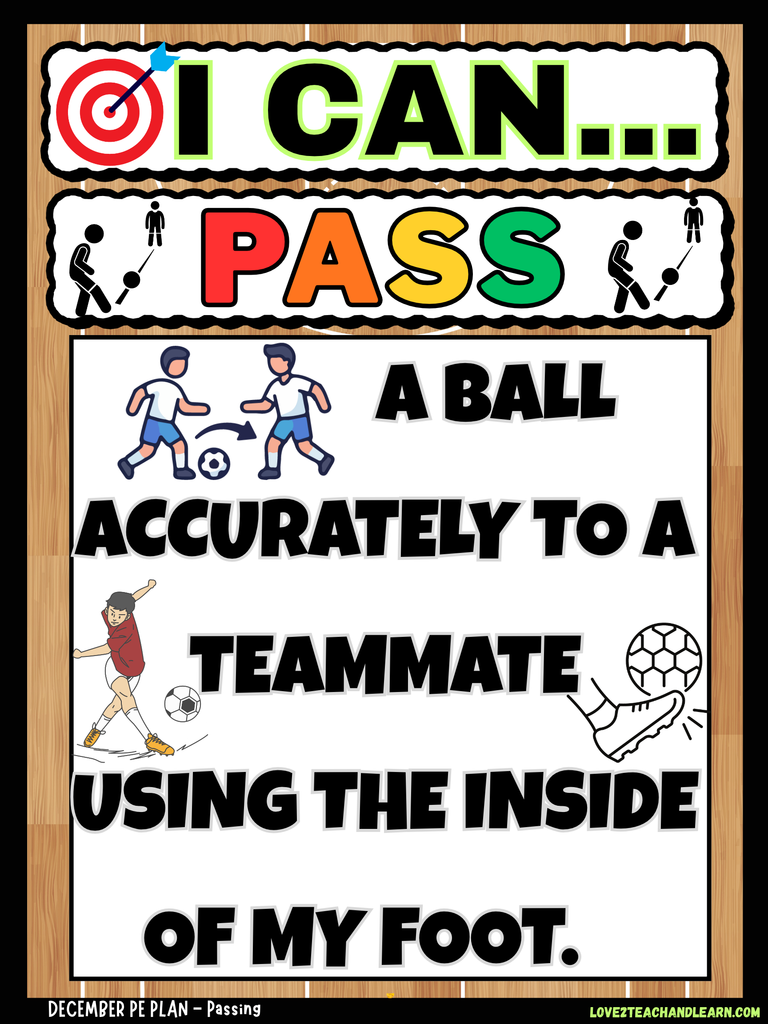
- I CAN… PASS A BALL ACCURATELY TO A TEAMMATE USING THE INSIDE OF MY FOOT.
READ ALOUD CONNECTION: Revisit The Soccer Fence by Phil Bildner.
ASK students: “What makes someone a GREAT teammate?”
MODEL the skill of passing for your students.
- Demonstrate facing a partner, looking at the target, stepping beside the ball with your non-kicking foot, turning your passing foot outward, and striking the ball with the inside of your foot.
- Emphasize following through toward the target.
- Show students how to adjust the amount of force depending on how far away their partner is standing.
CUE WORDS & SUCCESS CRITERIA
TEACH CUE WORDS – I like to use four simple cues for passing:
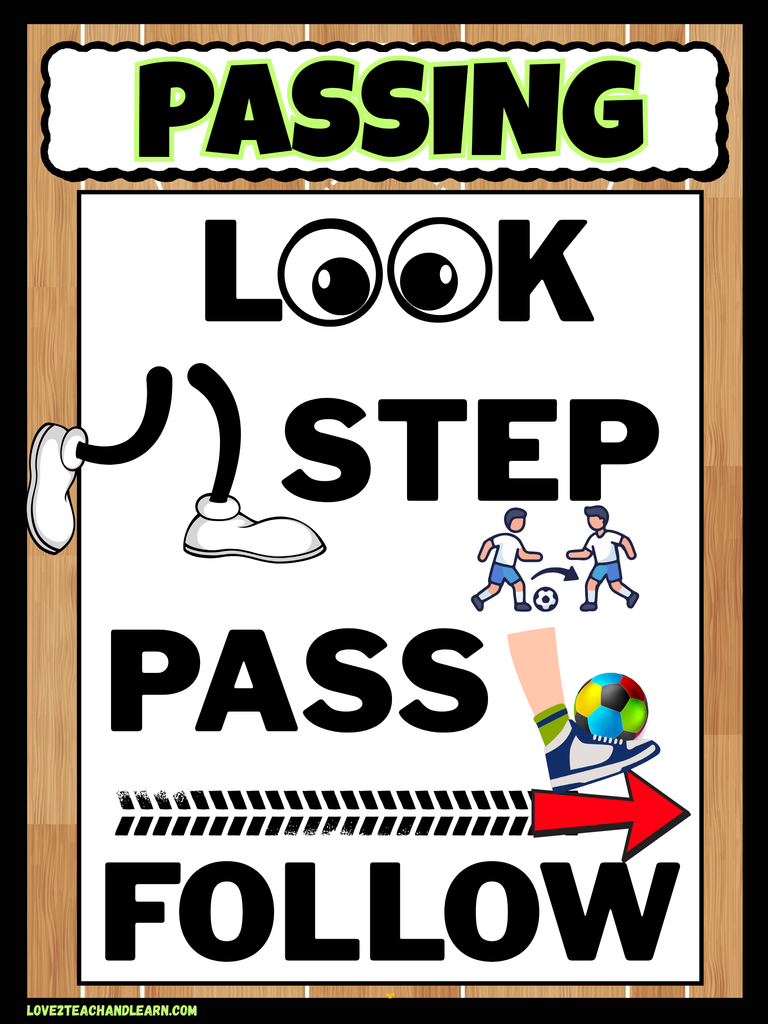
LOOK – STEP – PASS- FOLLOW
PASSING CUE WORDS
- 👀 LOOK – Keep your eyes on your target.
- 👟 STEP – Step beside the ball with your non-kicking foot.
- ⚽ PASS – Strike the ball with the inside of your foot.
- ➡️ FOLLOW – Follow through toward your partner or target.
⭐ EXPLAIN SUCCESS CRITERIA – I am successful when I LOOK at my target, STEP beside the ball, PASS with the inside of my foot, and FOLLOW THROUGH toward my teammate.
STUDENT PRACTICE ACTIVITIES
PRACTICE – Begin with short, stationary passes before increasing distance and adding movement.
Here are several fun passing practice activities:
- 🤝 PARTNER PASSING – Partners stand a short distance apart and practice passing a ball back and forth using the inside of their feet.
- 🎯 PASS THROUGH THE GATE – Set up two cones to create a gate between partners. Students try to pass their ball through the gate to their teammate.
- 🌈 RAINBOW PASSING – Create six different colored passing gates. Partners work together to successfully pass through each color.
- 🔺 TRIANGLE PASSING – Groups of three stand in a triangle and practice passing clockwise and counterclockwise.
- 🔢 COUNT YOUR PASSES – Partners count how many accurate passes they can complete in a row without losing control of the ball.
- 👟 PASS AND MOVE – After passing to a teammate, students move to a new open space to receive another pass.
- 🔄 RIGHT FOOT, LEFT FOOT – Challenge students to practice passing with both feet.
DIFFERENTIATE
- K–2: Begin with partners standing close together using larger, softer balls. Focus on making contact with the inside of the foot and passing toward a stationary partner.
- 3–5: Increase passing distances, introduce smaller gates, and add moving partners. Challenge students to use both feet, adjust their force, and communicate before passing.
FAVORITE MAIN PE PASSING GAMES
PLAY FUN PASSING PRACTICE GAMES – Here are four fun games that encourage accurate passing and teamwork!
- 🥔PASS THE POTATO – Give each pair of students one soccer ball and have them spread out around the gym. While upbeat music plays, partners use the inside of their feet to PASS their soccer ball back and forth, trapping it before each pass. When the music stops, whoever has the HOT POTATO must complete a silly dance or exercise before the music starts again!
- 🏃SOCCER PASSING RELAY RACE – Divide students into relay teams of 4–5 and have teammates line up several feet apart. On the GO signal, teams pass their soccer ball from one player to the next using ONLY their feet! Once the ball reaches the final player, they dribble it back to the beginning and start another round. The first team to complete a designated number of rounds WINS!
- 💰⚽ MONEY PASSES -Set up colorful cone gates throughout the gym with buckets of fake money beside each one: $1 for easy passes, $5 for medium passes, and $10 for challenging passes! Students work at their OWN PACE, using their soccer balls to make accurate passes through the gates and collecting ONE bill from the corresponding bucket for every successful pass! When the music stops, students count up their CASH, and the player who earned the MOST MONEY WINS!
ASSESSMENT
ASSESSMENT – 3-ATTEMPT PASSING CHALLENGE
Have students complete three passes toward a partner or designated target from the same starting position.
Look for five simple criteria:
- LOOKS at the intended target.
- STEPS beside the ball with the non-kicking foot.
- CONTACTS the ball with the INSIDE of the foot.
- FOLLOWS THROUGH toward the target.
- Uses appropriate FORCE and ACCURACY.
The goal is to complete a controlled pass that reaches the intended target, not simply kick the ball as hard as possible!
📋A quick checklist makes it easy to identify students who have mastered basic passing and those who need additional practice.
RECEIVING ⚽
Now that students have learned how to PASS a soccer ball, it’s time to work on the other half of that important skill—RECEIVING!
Passing and receiving go hand in hand because a successful soccer play requires one student to send the ball and another student to control it.
While trapping focuses on stopping a moving ball, receiving takes that skill one step further by teaching students how to control a pass and prepare for their NEXT MOVE!
HOW TO TEACH IT
QUICK INTRO
DEFINE and EXPLAIN what receiving actually is. The kid-friendly definition I use is:
- Controlling a ball that someone passes to you and getting it ready for your next move.
MAKE A REAL-WORLD CONNECTION – Ask your students: “What happens when your teammate passes you the soccer ball but you can’t control it?”
- Explain that receiving helps players keep possession of the ball instead of letting it roll away or allowing the other team to take it.
- Discuss how receiving and passing work together in soccer and other team games.
- Remind students that great receivers are always READY for the ball!
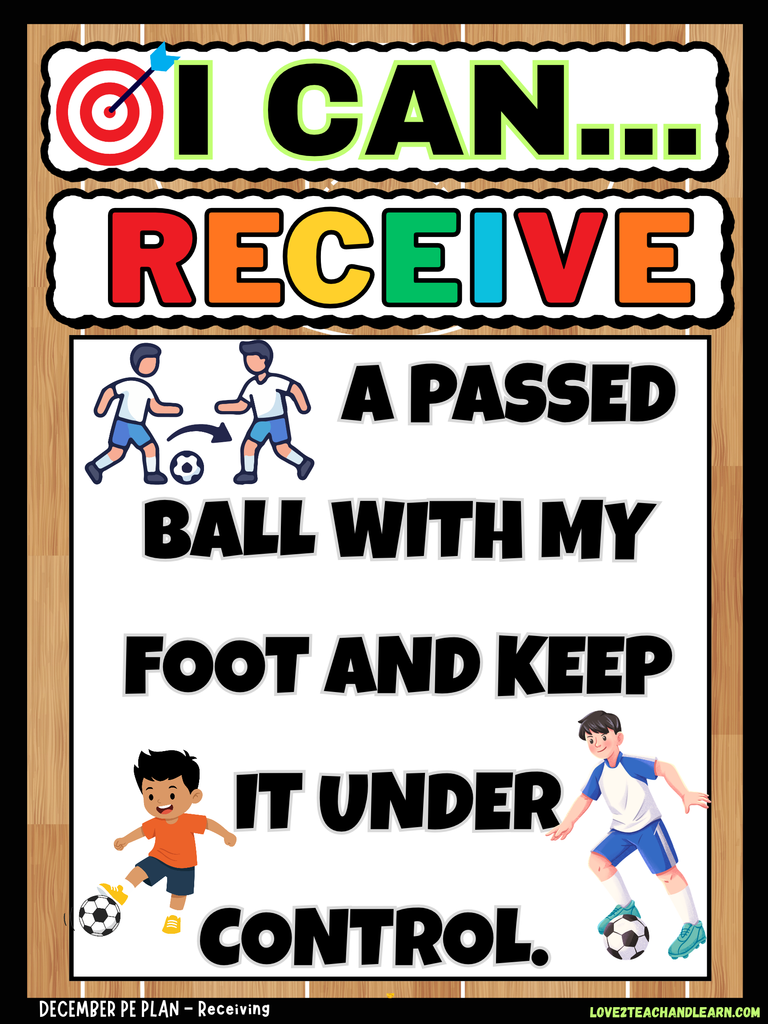
RECITE – Then have students recite the receiving “I CAN” Statement:
- I CAN… RECEIVE A PASSED BALL WITH MY FOOT AND KEEP IT UNDER CONTROL.
MODEL the skill of receiving for your students.
- Have a student gently pass a ball toward you.
- Demonstrate keeping your eyes on the approaching ball, moving into its path, and using the inside of your foot to gently cushion and control it.
- Show students how to guide the ball into open space so it’s ready for a pass, dribble, or shot.
EXPLAIN THE DIFFERENCE BETWEEN TRAPPING AND RECEIVING
- Trapping is primarily about stopping and controlling the ball. Receiving includes controlling the incoming ball and preparing for what comes NEXT!
Sometimes the best receive brings the ball to a complete stop. Other times, a gentle first touch guides the ball into open space.
CUE WORDS & SUCCESS CRITERIA
TEACH CUE WORDS – I like to use these four simple receiving cues:
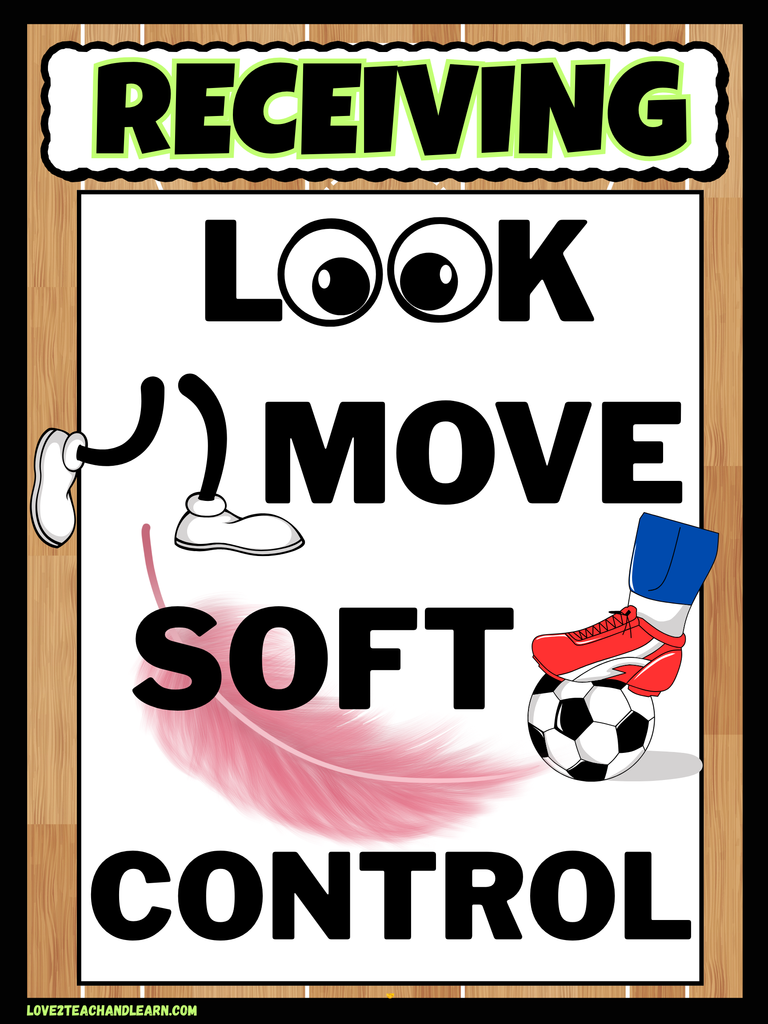
LOOK – MOVE – SOFT – CONTROL
RECEIVING CUE WORDS
- 👀 LOOK – Watch the approaching ball.
- 👟 MOVE – Move into position to receive the pass.
- ⚽ SOFT – Use a soft, gentle touch to cushion the ball.
- ⭐ CONTROL – Keep the ball close and prepare for your next move.
⭐ EXPLAIN SUCCESS CRITERIA – I am successful when I LOOK at the approaching ball, MOVE into position, use a SOFT touch with my foot, and keep the ball under CONTROL for my next move.
STUDENT PRACTICE ACTIVITIES
PRACTICE – Begin with simple partner receiving activities and gradually introduce movement and decision-making.
Here are several easy receiving practice activities:
- 🤝 PASS AND RECEIVE – Partners practice passing and receiving a ball back and forth. Encourage students to stop or cushion the ball before returning the pass.
- 👟 SOFT FOOT CHALLENGE – Partners send gentle passes and challenge each other to receive the ball without letting it bounce or roll too far away.
- 🎯 RECEIVE ON THE SPOT – Place a poly spot in front of each student. Their partner passes the ball, and they try to receive it while keeping it close to their spot.
- 🔄 RECEIVE AND TURN – Students receive a pass, turn their body, and dribble toward a new target.
- 🔺 TRIANGLE RECEIVE – Groups of three pass the ball around a triangle, practicing receiving and controlling it before passing to the next player.
DIFFERENTIATE
- K–2: Use larger, softer balls and short passing distances. Allow students to stop the ball completely before returning a pass.
- 3–5: Encourage students to cushion the ball with the inside of their foot, receive from different directions, and use their first touch to move into open space. Add simple defensive pressure when students are ready.
FAVORITE MAIN PE RECEIVING GAMES
PLAY FUN RECEIVING PRACTICE GAMES – Here are two games that combine receiving with passing, teamwork, and movement!
- 📦 SPECIAL DELIVERY SOCCER – This is a CRAZY FUN soccer passing team competition that combines passing accuracy, ball control, and teamwork! Divide students into teams of 3–4 and give each team a soccer ball and several DELIVERY STATIONS marked with colorful poly spots. Students work together to PASS their soccer ball from one delivery station to the next, making sure each teammate successfully receives and controls the ball before passing it along! Every time a team completes a FULL DELIVERY ROTATION, they earn ONE PACKAGE (beanbag) to add to their team’s collection! When the music stops, teams count up their deliveries, and the team that collected the MOST PACKAGES WINS!
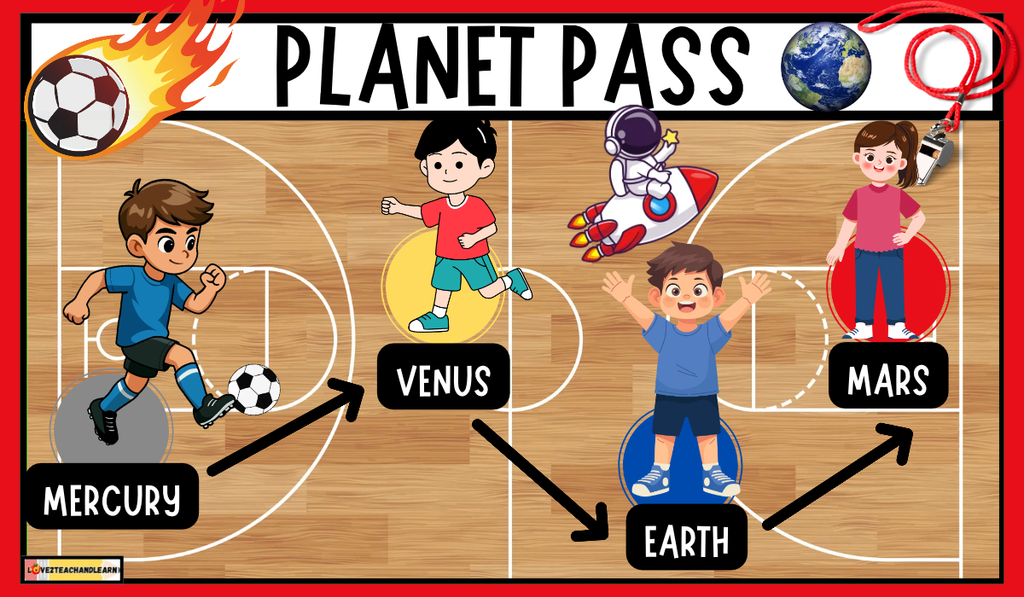
- 🌎PLANET PASS – This is an OUT-OF-THIS-WORLD soccer passing and receiving relay game that challenges students to work together to send their soccer ball on a journey through SPACE! Divide students into relay teams and arrange colorful poly spots in a pathway down the gym to represent different PLANETS. Each teammate stands on a planet and must successfully RECEIVE, CONTROL, and PASS the soccer ball to the teammate waiting on the next planet! Once the soccer ball reaches the FINAL PLANET, the last player passes it back through the planets in reverse order until it returns to EARTH (the starting line)! The first team to successfully complete their round-trip SPACE MISSION WINS!
ASSESSMENT
ASSESSMENT – 3-ATTEMPT RECEIVING CHALLENGE
Have a partner pass a ball toward each student three times.
Look for five simple criteria:
- LOOKS at the approaching ball.
- MOVES into position to receive it.
- Uses a SOFT touch to cushion the ball.
- Keeps the ball CLOSE and under CONTROL.
- PREPARES the ball for the next movement or pass.
Encourage students to improve their receiving control from Attempt #1 to Attempt #3.
📋A quick checklist makes it easy to identify students who have mastered the basic receiving skills and those who need additional practice.
SHOOTING ⚽🥅
We’ve made it to our FINAL December PE skill, and this one is always a STUDENT FAVORITE—SHOOTING!
After spending the month learning how to kick, trap, dribble, pass, and receive a soccer ball, students are finally ready to put ALL of those skills together and take a SHOT ON GOAL!
Shooting is an exciting way to finish our foot skills unit because it combines accuracy, force, coordination, balance, and teamwork.
And of course, there’s nothing quite like the excitement of scoring a GOAL!
HOW TO TEACH IT
QUICK INTRO
DEFINE and EXPLAIN what shooting actually is. The kid-friendly definition I use is:
- Using your foot to kick a ball toward a goal with accuracy and the right amount of force.
MAKE A REAL-WORLD CONNECTION – Ask your students: “What do soccer players need to do before they can score a GOAL?”
- Give students a chance to brainstorm ideas like dribbling, passing, receiving, moving into open space, and aiming.
- Explain that shooting is the final step in many soccer plays, but a successful shot often depends on all the other skills we’ve practiced throughout December!
- Remind students that a POWERFUL shot isn’t always the BEST shot. Sometimes a gentle, accurate kick is exactly what it takes to score!
RECITE – Then have students recite the soccer shooting “I CAN” Statement:
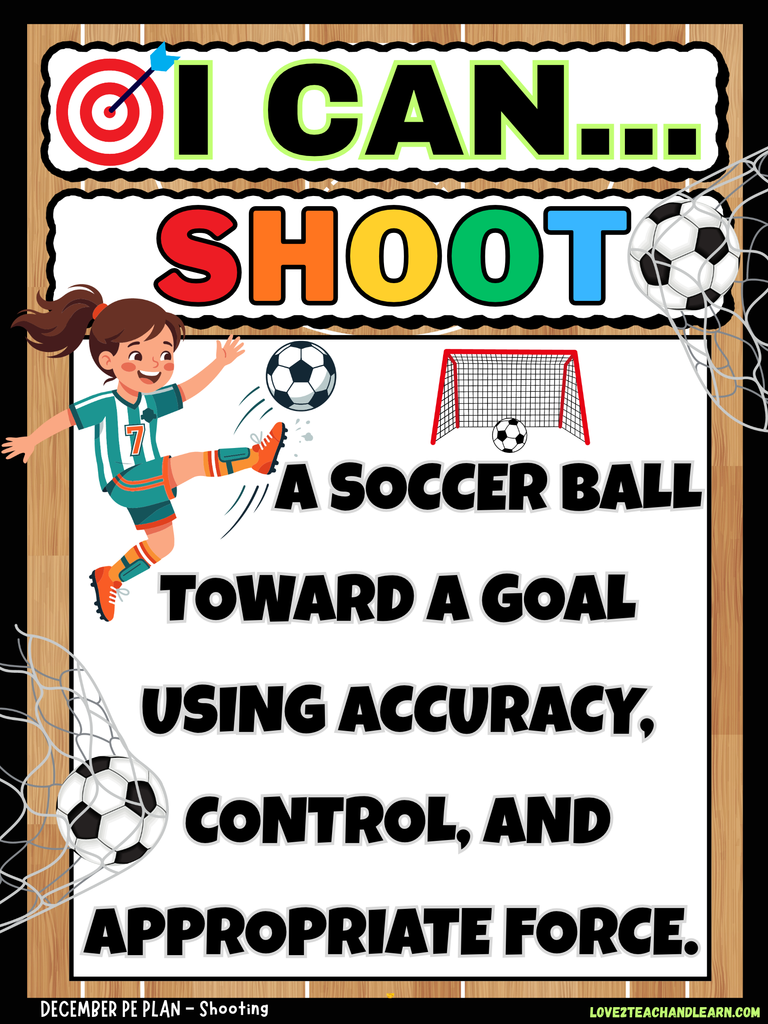
- I CAN… SHOOT A SOCCER BALL TOWARD A GOAL USING ACCURACY, CONTROL, AND APPROPRIATE FORCE.
READ ALOUD THE BOOK: Soccer Star by Mina Javaherbin.
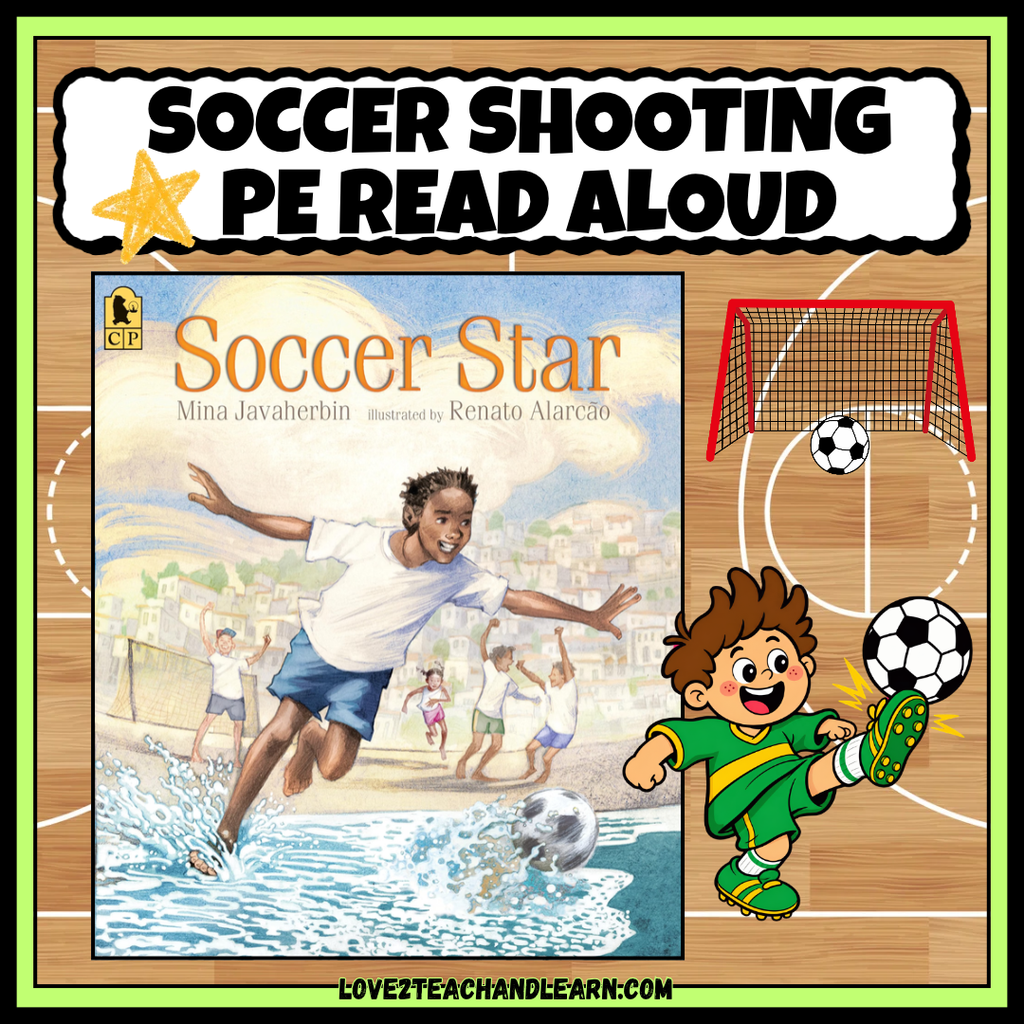
This inspiring soccer story provides a wonderful opportunity to discuss dreams, perseverance, teamwork, and the importance of believing in yourself.
It also makes a great closing read-aloud for our December foot skills unit! If you don’t have the actual book you can listen to the read aloud RIGHT HERE.
MODEL the skill of shooting for your students.
- Demonstrate looking at the goal, approaching the ball, placing your non-kicking foot beside it, striking the ball with the inside of your foot or shoelaces, and following through toward the goal.
- Show students the difference between shooting for accuracy and shooting for power.
- Emphasize that students should aim for OPEN SPACE inside the goal rather than simply kicking as hard as possible.
CUE WORDS & SUCCESS CRITERIA
TEACH CUE WORDS – I like to use four easy cues:
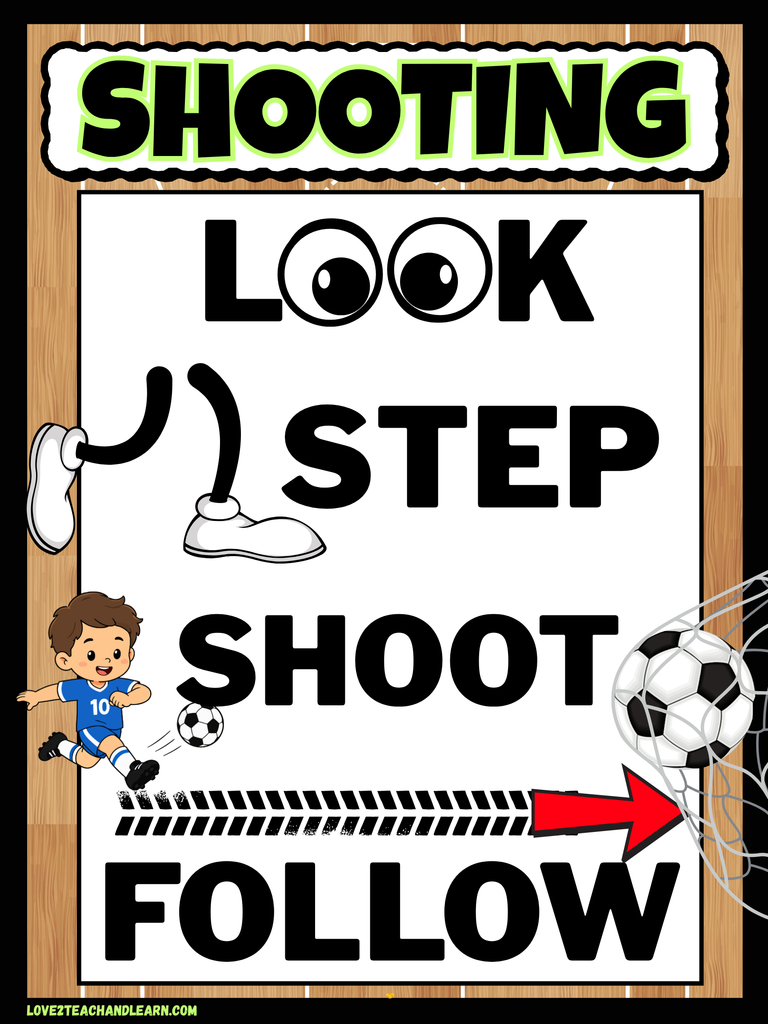
LOOK – STEP – SHOOT – FOLLOW
SHOOTING CUE WORDS
- 👀 LOOK – Look at the goal and choose your target.
- 👟 STEP – Place your non-kicking foot beside the ball.
- ⚽ SHOOT – Strike the ball toward the goal using the appropriate amount of force.
- ➡️ FOLLOW – Follow through toward your target.
⭐ EXPLAIN SUCCESS CRITERIA – I am successful when I LOOK at my target, STEP beside the ball, SHOOT with accuracy and appropriate force, and FOLLOW THROUGH toward the goal.
STUDENT PRACTICE ACTIVITIES
PRACTICE – Begin with large goals and stationary balls before progressing to moving shots and more challenging targets.
Here are several fun shooting practice activities:
- 🥅 SHOOT ON GOAL – Students practice shooting a stationary ball into a large goal from a short distance.
- 🎯 PICK YOUR CORNER – Place two colored cones inside a goal. Students choose a corner and try to shoot their ball toward that target.
- 🌈 RAINBOW GOALS – Create six different colored goals or shooting targets around the gym. Students practice shooting toward each one.
- 👟 DRIBBLE AND SHOOT – Students dribble their ball toward a designated shooting line and then take a controlled shot on goal.
- 🤝 PASS AND SHOOT – Partners practice passing, receiving, and shooting. One student passes the ball, and the other receives it before taking a shot.
- 🔢 SHOOTING POINT ZONES – Divide a large goal into three target zones. Students earn different point values depending on where their ball enters the goal.
- ⚽ RIGHT FOOT, LEFT FOOT – Challenge students to practice shooting with both feet.
DIFFERENTIATE
- K–2: Use large goals, soft soccer balls, short shooting distances, and stationary balls. Focus on making successful contact and shooting toward the target.
- 3–5: Introduce smaller goals, longer shooting distances, moving balls, and shooting after dribbling or receiving a pass. Encourage students to adjust their force and aim for open spaces.
FAVORITE MAIN PE SHOOTING GAMES
PLAY FUN SHOOTING PRACTICE GAMES – Now it’s time to finish December with some seriously CRAZY FUN soccer games!
- SOCCER GOLF – This is one of my absolute favorite kicking practice games. Soccer Golf is a creative, easy-to-set-up outdoor game, that helps build kicking accuracy, teamwork, and giant smiles. Get all of the “How to Play” game details RIGHT HERE.
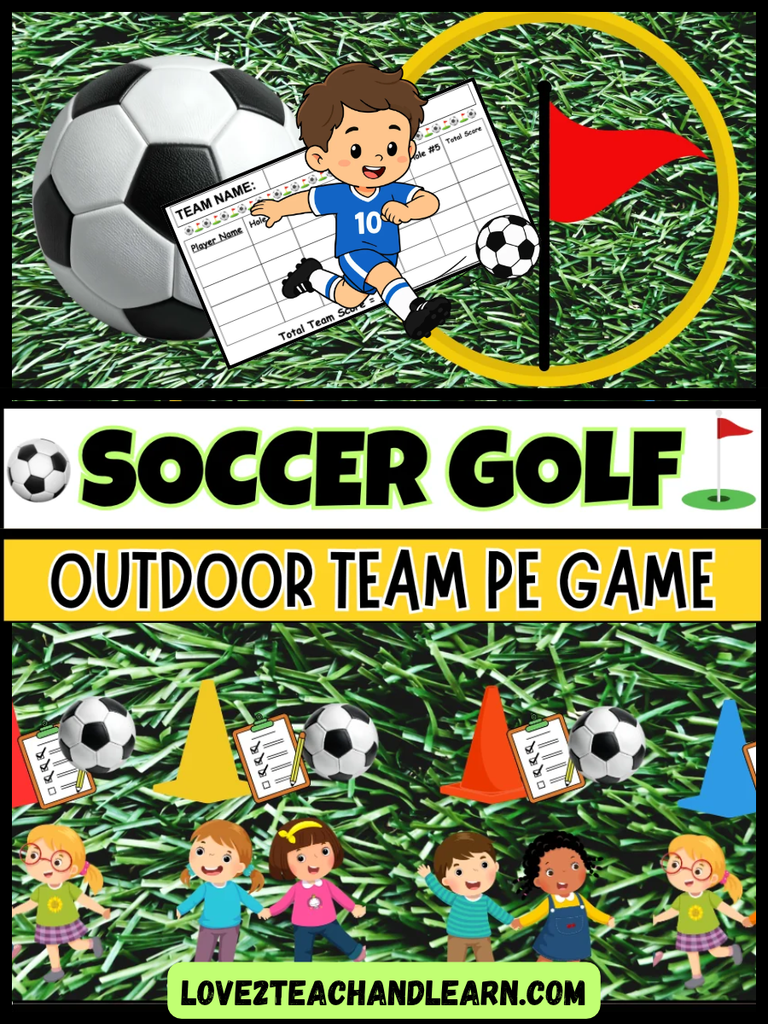
PLAY FUN SHOOTING PRACTICE GAMES – Now it’s time to finish December with some seriously CRAZY FUN soccer games!
- MILLION DOLLAR SOCCER SHOTS – Set up three shooting lines at different distances from the goal. Students earn $50 for scoring from the closest line, $100 from the middle line, and $1000 from the farthest line. Students collect play money after each successful shot and try to earn ONE MILLION DOLLARS—well, maybe not quite that much! LOL! Here’s where I get my PLAY MONEY from Amazon.
- SUPER SOCCER BOWLING – This is a CRAZY FUN twist on traditional bowling that’s PERFECT for practicing soccer SHOOTING accuracy, direction, and force! Divide students into teams of three and have them take turns SHOOTING their soccer balls toward a set of bowling pins, with TWO attempts to knock down as many pins as possible! Teammates rotate between SHOOTER, PIN SETTER, and SCOREKEEPER, and after four rounds of play, teams add up their scores to see who knocked down the MOST PINS!
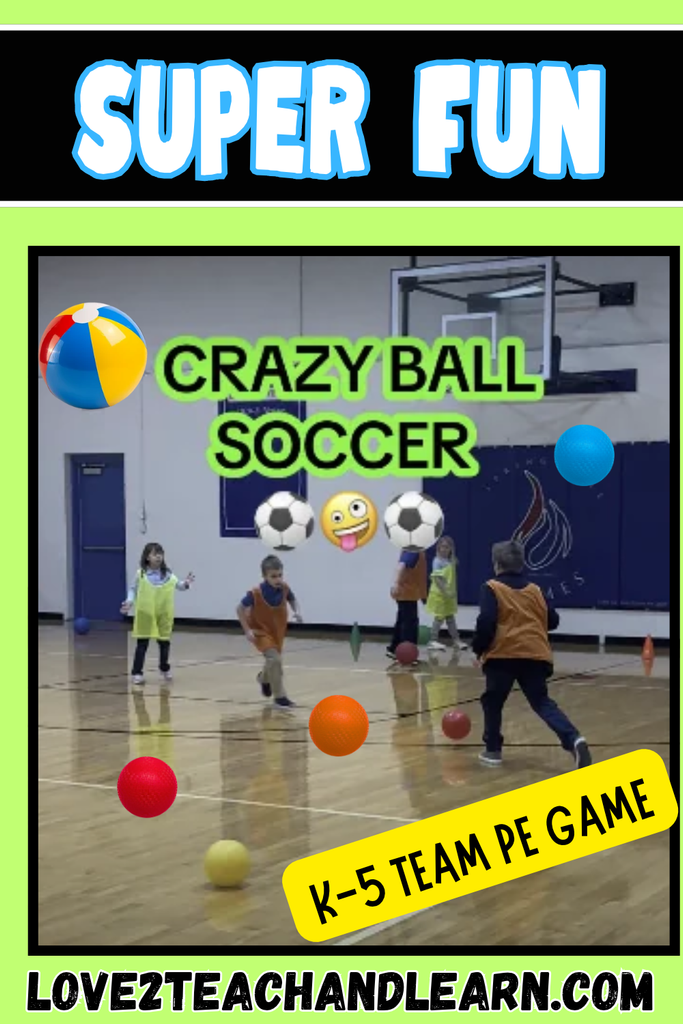
- ⚽🥅 CRAZY BALL SOCCER is a fast-paced, CRAZY FUN soccer game that’s PERFECT for practicing SHOOTING, kicking, dribbling, passing, and teamwork! Divide students into TWO teams, set up a soccer goal at each end of the gym, and scatter LOTS of soft balls (beach balls, Gator Skin balls, etc.) throughout the playing area. Students work together to kick, pass, and SHOOT as many balls as possible into their team’s designated goal! There are NO GOALIES, NO ELIMINATIONS, and NONSTOP ACTION! Every time a student scores, they return the ball to the game and give the teacher a HIGH FIVE to celebrate their GOAL!
- 🏆WORLD CUP MINI GAMES – Divide students into small teams and create several mini soccer fields using cones and small goals. Students play short 3-on-3 or 4-on-4 games, focusing on the skills they’ve practiced throughout December. Encourage students to dribble with control, pass to teammates, receive the ball, and take accurate shots on goal. Rotate teams every few minutes so students have opportunities to play with different classmates.
ASSESSMENT
ASSESSMENT – 3-ATTEMPT SHOOTING CHALLENGE
Give each student three opportunities to shoot a soccer ball toward a goal from the same starting position.
Look for five simple criteria:
- LOOKS at the goal and identifies a target.
- STEPS beside the ball with the non-kicking foot.
- CONTACTS the ball with the inside of the foot or shoelaces.
- FOLLOWS THROUGH toward the target.
- Demonstrates ACCURACY and APPROPRIATE FORCE.
Encourage students to adjust their aim and force after each attempt.
The goal isn’t necessarily to score every time—it’s to demonstrate proper shooting form, control, and improvement!
📋A quick checklist makes it easy to identify students who have mastered the basic shooting and those who need additional practice.
CELEBRATE OUR DECEMBER FOOT SKILLS! 🎉⚽
WOW! We’ve made it through another month of learning, practicing, and having some serious FUN in elementary PE!
Throughout December, our students have worked hard to develop six essential foot skills: KICKING, TRAPPING, FOOT DRIBBLING, PASSING, RECEIVING, and SHOOTING.
THAT’S A WRAP – Almost
And that wraps up our 6 essential PE skills for December! But before we call Month #4 complete, I couldn’t finish a December PE Plan without adding a little extra holiday Fun.
I’m including a special DECEMBER BONUS HOLIDAY SECTION with a few of my absolute favorite MUST-PLAY December and Christmas PE games—perfect for keeping your K–5 students moving, laughing, and having FUN as you head into Winter or Christmas break!
DECEMBER BONUS PE GAMES
Here are a few of my absolute favorite December Holiday Games:
- HOME ALONE HEROES (Strategy, Teamwork) PE Game – Get all the “How to Play” directions RIGHT HERE.
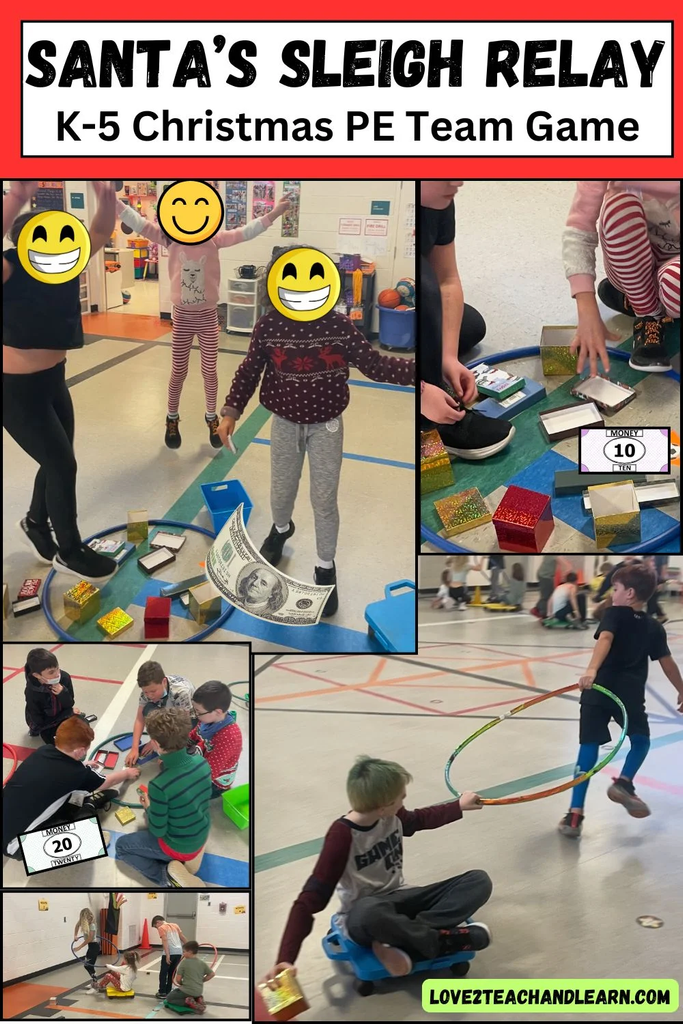
- SANTA’S SLEIGH RELAY – Get all the “How to Play” directions RIGHT HERE.
- MYSTERY GRINCH TAG – Get all the “How to Play” directions RIGHT HERE.
- 10 CHRISTMAS STATIONS & RELAYS – Get all the “How to Play” directions RIGHT HERE.
CLASS DISMISSED
And there you have it — Our December PE Plan is in the books! Here’s to an awesome month of learning, moving, laughing, and making some CRAZY FUN PE memories with your students!
LET’S CONNECT
If you’re a PE Teacher, I’d love to connect with you. You can find me hanging out in all of these Amazing places.
Mrs. T’s “Always Growing” PE Games Bundle
Hey Friend – Are you a K-5 PE Teacher looking to save MASSIVE time?
With my *HUGE – 500+ Pages* FULL YEAR Elementary PE Resource “ALWAYS GROWING” BUNDLE you will save SO MUCH VALUABLE planning time…
AND… you’ll be prepared for every PE class with creative, unique, and SUPER FUN skill-based games that your PE students will ABSOLUTELY LOVE!
You can check out my GIANT MEGA BUNDLE Right Here!
Oh, and if you want the BIGGEST BANG FOR YOUR BUCK – My DECEMBER PE PLAN BUNDLE is already included in my MEGA “Always Growing” Bundle. How Cool is That?
Hey – Thanks so much for stopping by today to check out my DECEMBER PE PLAN.
I really appreciate it and I hope your day is filled with plenty of FUN and FITNESS.
Oh, and remember PE Friends… IF YOU HAD FUN, YOU DEFINITELY WON!